
Dartmoor National Park Guide: Best Things to Do, Walks & Hidden Gems
Last Updated on 31st July 2026 by Sophie Nadeau
This post may contain affiliate links. Please check out my privacy policy and disclosure for more information.
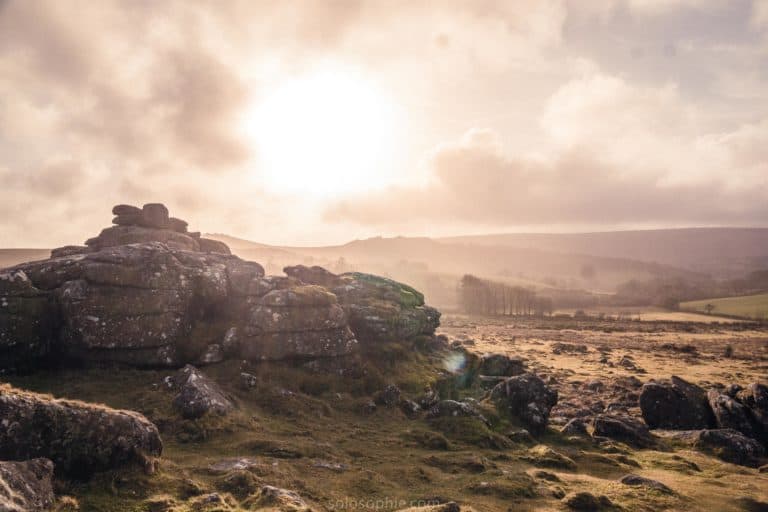
Ancient and shrouded in mystery, Dartmoor is home to many a myth and local legend. Located in Devon, it’s a real gem of South West England. As well as a rich history and good food scene, the National park has plenty of must-see attractions and activities to suit nearly every interest.

Introducing Dartmoor National Park
When you think of the English countryside, your mind probably conjures up images of rolling green hills and plenty of fluffy sheep. But what you may not know is that there are a number of National Parks in the UK, many of them wild and mysterious.
And one of my favourite parks of all is that of Dartmoor, a barren landscape set atop of the remains of volcanic activity… If you’re visiting the area for the first time, then consider checking out our one day in Dartmoor itinerary.
How long do you need in Dartmoor?
Dartmoor is a medium sized National Park and so can easily be covered over the course of two or three days. If you would prefer to check out more of the towns and villages, as well as cosy up in a few of the pubs, and go on a few hikes, then you’ll want to spend four days in the park.
Best things to do in Dartmoor National Park
Wander around Haytor Quarry
‘Haytor is a honeypot’– I still hear my Year 8 Geography teacher’s voice ringing in my ears when I close my eyes. And that’s because she wasn’t wrong! Just a few miles from the quaint town of Bovey Tracey, on the edge of the Moor, you’ll find Haytor.
One of the most famous of all Dartmoor Tors, each year it attracts thousands of visitors from far and wide. And to the base of the granite outcrop lies a hidden lake, secluded and all that remains of the abandoned Haytor Quarry. Head here to enjoy a tranquil moment and observe all of the wildlife that now calls this little lake ‘home’…

Admire Bowerman’s Nose
On Hayne Down, if you look closely enough, you’ll see the faint shape of a man, carved out of the granite. Although of course, it was time and the last Ice Age that left this creepy mark on the landscape, local legend has it that this is all that remains of Bowerman.
In the Dartmoor myth, Bowerman was a fearless hunter who ran across the moors with his pack of dogs. One day, he disrupted a coven of witches (who were abundant on Dartmoor at that time) while they were performing a spell.
In their anger, the witches transformed both Bowerman and his hounds into rocks. The larger rock is supposedly Bowerman, while the smaller ones scattered below about are meant to be his dogs. Head to Bowerman’s Nose for amazing walks and picturesque scenery. Read more: Mythical Dartmoor, the history, and the legends behind the reality.

Cross Postbridge Clapper Bridge
The little Clapper Bridge in Postbridge on the very middle of Dartmoor has provided safe passage across the river for centuries. It’s easily one of the best things to do in Dartmoor and can easily be visited en route to Princetown or another popular Dartmoor attraction.
Dating all the way back to the middle ages, no trip to must-see Dartmoor places would be complete without a quick walk across this ancient passageway and, of course, snapping a photo or two!
Enjoy snowdrops during the spring
When the ground is still frozen, the mornings remain dark and chilly, and a frost permeates the air, there’s one flower that blooms before any other each and every year, that of the snowdrop. Pretty, little and delicate this flower is the first to spring from the ground after the dreary winter and can be found in hedgerows throughout the UK.
Snowdrops on Dartmoor can be seen from the end of January right through until the end of February and beginning of March, dependent entirely on that year’s winter weather. In the rest of the UK, The spring bloom can be found in fields, gardens, and pretty much anywhere else that wildflowers manage to grow.
So, if you’re headed to the islands in the earlier months of the year, keep an eye out for these delicate flowers. When it comes to the wild landscape of Dartmoor National Park, one of the very best spots to see the early spring flowers is around the outside of the quaint Huccaby Church.

See Venford Falls
The mystical falls of Venford are secluded in a little copse of woodland not far from Venford Reservoir. Beautiful and mystical, they can only really be visited in the summer months and in dry weather.
If you do decide to visit, then just make sure to bring a tripod in order to capture the falls in a ‘fairytale-like’ way! While there, you may want to stroll around the fairly flat Venford Reservoir, which is pretty picturesque in of itself.

Visit Widecombe-in-the-Moor
The quaint village of Widecombe-in-the-Moor lies in the very heart of the Dartmoor landscape. Situated in its own valley overlooked by countless tors, it’s a little Devonian village filled with pubs, cafés and little shops. Widecombe-in-the-Moor is the perfect place to enjoy a local cream tea or sample one of the many local beers on offer…

Make a trip to Grimspound, a 3000-year-old settlement
This neolithic village of Grimspound is situated on one of the highest points of the moor. Once upon a time, this now abandoned settlement was home to dozens of people and their livestock. Today, it is hard to imagine how people could have made such a barren landscape their home (there’s even a shortage of phone signal here).
However, thousands of years ago, the landscape of Dartmoor was a very different place and filled with trees. That’s not to say it wasn’t a difficult place to live though! Now, you can visit the remains of the settlement and wander through the ancient houses, some of which have been partially reconstructed.
Visit Hound Tor Abandoned Medieval Village
To the base of Hound Tor, you’ll find another abandoned village. Dating all the way back to medieval times, no one knows quite why this village was so utterly abandoned, or what happened to all of its residents.
Today, you can visit the ruins of the houses and imagine what life must have been like centuries ago. Famous writer Sir Arthur Conan Doyle set one of his Sherlock Holmes Novels on Dartmoor, naming it ‘Hound of the Baskervilles’ as a nod to ‘Hound Tor’.
Be amazed by Brentor Church
Of all the top Dartmoor attractions on this list, Brentor is probably the quirkiest. The little place of worship dedicated to St Michael is situated at the very top of an extinct volcano. The church is dedicated to the Archangel Michael like so many churches in the area.
Other St Michael Churches can be found on St Michael’s Mount and at Rame Head. There is no road leading up to the chapel, and you often hear tales of brides hiking up to the small church in their Wellington Boots!
Enjoy a Cream Tea in Ashburton
One of the best things to do in Dartmoor National Park if you love vintage shopping and delicious food, is to visit Ashburton. Full of quirky antique shops and vintage boutiques, Ashburton is worth a visit if you love shopping and curios. The ancient stannary town also happens to be home to one of the best places to enjoy a cream tea in Dartmoor, Taylor’s Tea Room.
Head to Ashburton to wander the ancient market town, see the shops and sample a regional specialty, the cream tea. Just make sure to spread the cream before you add the jam- after all, this is the Devonian way!

Visit Dartmoor Prison Museum
Dartmoor prison is still a working prison, high up on the expanses of Dartmoor, in the town of Princetown. Associated with the prison, you’ll find Dartmoor Prison Museum, where you can find out plenty of information on prison life throughout the ages. The prison dates all the way back to 1809 and was constructed by Napoleonic and American prisoners of war.

Walk the Haytor Tramway
To the base of Haytor rocks, you’ll find all that remains of the Haytor Tramway. On this part of the moors, granite quarrying was once the greatest industry and provided hundreds of people with steady jobs.
Haytor was home to one of the largest quarries on the moor. And from here, the granite was transported all the way down to nearby Bovey Tracey via horse and cart along granite slabs.
Today, you can wander along the remains of the Haytor Tramway and admire the gorse and heather bushes, as well as the fantastic views all the way over to the sea in Torquay. You’ll also probably get the chance to see some Dartmoor ponies up close as they tend to hang about in this area (just remember not to feed them!)

Visit Castle Drogo, the last Castle to be built in England
The imposing and grand residence of Castle Drogo is the last castle to have been built in England. It even has a working portcullis (though this was never actually used)! The castle was built in the early 1900s, commissioned by Julius Drewe.
Drewe had made his fortune in tea trading and retired at the young age of 33. It was designed by the famous Architect, Edwin Lutyens, who also designed the Cenotaph in London among other things.
Wander around Lustleigh, the prettiest Village in Dartmoor
Full of quirky little cottages and thatch rooftops, Lustleigh is regularly cited as the prettiest village in Dartmoor. Head here if you love quaint houses, woodland walks, and Neolithic Sites. (In the Cleave, a wooded area just outside of the village, you’ll find the remains of various stone huts.)
When it comes to the quaint village of Lustleigh, it’s also worth noting that there is a village pub, as well as a cute little tea room where you can enjoy a selection of homemade cakes and warm drinks during the spring, summer, and early fall. Read more: Lustleigh Guide, best things to do in the prettiest village in Dartmoor.

See Lydford Gorge, Castle, and Village
Lydford has a long and rich history. As a result, there’s plenty of things to do in the village and its surrounds. Once inhabited by the Vikings, today you can see the ruins of ‘Lydford Castle’ which was used as a prison in the middle ages.
Step away, there are the ruins of a Castle dating back to Norman times. Nearby, you’ll also find Lydford Gorge, a mysterious area of woodland filled with small coves, streams and even a couple of waterfalls. Read more: Guide to Lyford Castle and Gorge.

Visit Chagford, an ancient Stannary Town
The ancient stannary town of Chagford dates all the way back to the Neolithic era (approximately 4000 years to be exact!) A market was held in the town on a weekly basis for centuries and it was designated a ‘stannary town’ by King Edward I in 1305.
The towns were essentially meant to process all tin mining in the area, making them some of the most important towns in all of Devon during that time. Today, you should visit Chagford if you love old architecture (some of the pubs here date back Centuries), shopping in independent boutiques, and eating local produce.

See Meldon Reservoir
The impressive body of water that forms Meldon Reservoir is located approximately 900 feet above sea level. Here, you can wander around the lake, snap a few picturesque photos and simply enjoy the beauty of Dartmoor. It’s easily one of the best things to do in Dartmoor National Park if you love hiking and photography.

Admire the springtime bluebells at Holwell Lawn
There’s nothing quite like the sweet fragrance of a thousand blooms permeating the air. And that’s exactly what you’ll find on a trip to Holwell Lawn in central Devon.
Each and every year come Spring Time, thousands upon thousands of bluebells bloom across the moorland. It’s pretty amazing to see, and one of the best spots is at Holwell Lawn, a field situated midway between Haytor and Hound Tor.
After all, these delicate violet flowers usually bloom for no longer than a week. Normally at some time between the beginning and middle of May. The exact blooming time of bluebells changes each year. Weather, rainfall and yearly temperatures all have a direct impact.
Holwell lawn lies between Hound Tor Rocks and Haytor; the two major touristic hotspots in the area. Haytor is the closest Tor to the town of Bovey Tracey, while Hound tor is often listed as the inspiration for Sherlock Holme’s ‘the Hound of the Baskervilles‘.
Hound Tor also home to an abandoned medieval village (and well worth a look if you’re ever in the area). The name ‘Holwell’ probably derives from a local holy well in the area, and indeed there are some 18th-century ruins in the field.
However, these are predominantly carpeted in purple for the majority of May. The lawn is fairly flat for this area of Dartmoor and little tough walking is required to see the bluebells due to the nature of the path winding through the middle of them.
As this is one of the most popular spots on the moorland for seeing the bluebells, I highly recommend arriving earlier in the day to avoid other tourists hoping to see the flowers.
There’s a limited number of parking spaces on the roadside directly opposite Holwell Lawn. Alternatively, there’s a lot of free parking at the base of Hound Tor car park. There, you can also find a mobile café serving hot food, cold food, and refreshments.

See the old School and chapel at Huccaby Church
Wander down a little narrow lane in the very heart of Dartmoor, and you’ll stumble across a church with an unusual function. Surrounded by woodlands and little else, the Huccaby Church of Saint Raphael is not only a place of worship for a dedicated congregation of churchgoers but also a small chapel school.
Saint Raphael is the patron of Apothecaries; Ordained marriage; blind people; bodily ills; WI (Women’s Institute); druggists; eye problems; guardian angels; happy meetings; insanity; lovers; mental illness; nightmares; nurses; pharmacists; physicians; shepherds; sick people; travellers; young people, among other things.
In this part of the moors, it’s easy to get lost. Narrow lanes wind deep into the countryside and each road looks just enough like the last to really confuse you. There’s no phone signal.
But then again, it’s on these kinds of adventures that you manage to stumble upon places such as this. Small gems, frozen in time. This small chapel has stood, as is, since it was built in the late 19th-century. And it has barely changed in all that time.
In 1868, the district of Huccaby lay in the very midst of a Dartmoor forest. It consisted of a few houses and even fewer farmsteads. The residents of this small community were expected to make the arduous (and in wet weather, downright dangerous) trek toLydford to attend church.
If the children of the local farmers wanted to attend school, they too were expected to make the journey to Lydford. By road, this trip is just under twenty miles long. As a result, few of the children from the farms were able to attend school on a regular basis.
The rector of Lydford saw this problem and thought about how to rectify it. He had Huccaby Church built so that the worshippers would not have so far to travel on a Sunday.
Now, of course, since as early as the 3rd and 4th centuries the church have been vital instruments in the dissemination of knowledge and information. During the week, the back of the chapel was therefore transformed into a schoolhouse for the children of local farmers.
Sadly, the Rector’s dreams of a flourishing school house never came to fruition. In wet weather, the children still found it hard to reach the little schoolhouse/ chapel. Roads were muddy and crossing streams and fields almost impossible in such bad conditions.
When the weather was good, the children were expected to stay at home and help out on the farm; meaning that they again couldn’t attend classes. By 1924, the chapel was closed. Poor attendance as a result of the chapel’s bad location was the main reason why.
Today, the desks, which can be folded down into pews still stand at the back of the church. The once open fireplace which was the sole means of heating the place has been replaced with a wood burning stove. Inkwells are still in the desks, a chalkboard is all that remains to tell the tale of a once ambitious dream…
Although the school at the back of the church is officially closed, the building itself is open during daylight hours throughout the week and services are held on special occasions.
Each year, on the weekend before Valentine’s day, and for the following few days, the church is open to visitors for cream teas and the annual Valentine’s Day sale of snowdrops.
For a small donation (at your discretion, suggested fee around £1), you can buy a little snowdrop for yourself to take home and plant in your garden. All proceeds go to the running of the church.

Visit Okehampton castle, once the largest castle in Devon
A set of abandoned hills and walls on the edge of the quaint town of Okehampton are all that remains of Okehampton Castle, once the largest castle in Devon. Today, you can visit the ruins of the castle, wander through the palace and learn about its rich history through an ever so helpful audioguide. Read more: Visiting Okehampton Castle, one thousand years of history in the making.

Marvel at Spinster’s Rock, an ancient Dolmen
In the middle of a farming field (where you’ll more often than not find sheep set out to graze), you’ll find the curious set of rocks which collectively form ‘Spinster’s Rock’. This Dolmen dates all the way back to Neolithic times and is supposedly a prehistoric burial site.
Due to the nature of the acidic soil on Dartmoor, no human remains can be found on site and so the ‘burial site’ theory has never been proven. But what makes Spinster’s Rock so fascinating is that it collapsed at some point in the 17th or 18th Centuries.
Local legend suggests that there were once three spinsters, who also happened to be witches, living nearby. One morning, before breakfast, the sisters set out and re-erected the stones, thus the name ‘Spinster’s Rock’.
Hike Rippon Tor
Hard to pinpoint on a map and even harder to reach, Rippon Tor is often missed out in favour of its more famous counterpart, the rocky outcrop of Haytor.
If you want to hike up to the top of Rippon Tor, you’ll find your first challenge is finding a space to park your car! Nevertheless, when you approach Rippon Tor from Bovey Tracey, you’ll see Saddle Tor to your right.
Carry on along the road and around the bend and you’ll see a small parking lot on the right-hand side, to the base of Saddle Tor. Park here and cross the road on foot. You’re now heading in the right direction to reach the top of Rippon Tor!
If you do decide to climb up to the top of the tor, a group of stones thought to have been left behind as a result of glacier movements during the last Ice Age, then make sure you’re prepared for the weather. After all, the mist can, and often does, descend with little warning, leaving you a little lost. Bring a windbreaker jacket and waterproof shoes.
The Tor still stands an impressive 473 metres above sea level, and on a clear day offers views all the way to the sea, and to the North Devon National Park of Exmoor. Climb up to the top and you’ll most definitely be rewarded for your efforts!
Some of the best highlights of a hike to Rippon Tor include:
- Nutcrackers Rock: This unusual formation of rocks is called Logan Stone and reputedly used to sway with the wind.
- Newhouse Inn Ruins: Just a few piles of granite are all that’s left of Newhouse Inn, a pub which burned down in the 1800s. There is little left to suggest that this was once a thriving drinking establishment that was a welcome refuge from the wild roads that crossed the open moorland.
- Iron Age Ruins: Near Rippon Tor, you’ll spot Bronze Age boundary walls, and several mounds which may well have been Bronze Age Hut circles.
- Medieval Rippon Tor Cross: Lying a few dozen metres from the tor’s trig point, there’s an unfinished cross lying on its side. This is thought to date back to medieval times, though it’s obviously hard to date the carving of stone!
- Trig Point at Rippon Tor: Once you reach the top of Rippon Tor, you’ll see the Trig Point, a small stone indicating that this is the highest point in the area. This Trig Point is in the top ten highest Trig Points on Dartmoor.
- Rippon Tor Cairns: There are three cairns at the top, including one which surrounds the Trig Point. These cairns likely were once used as the final resting place of bodies during the Bronze Age.
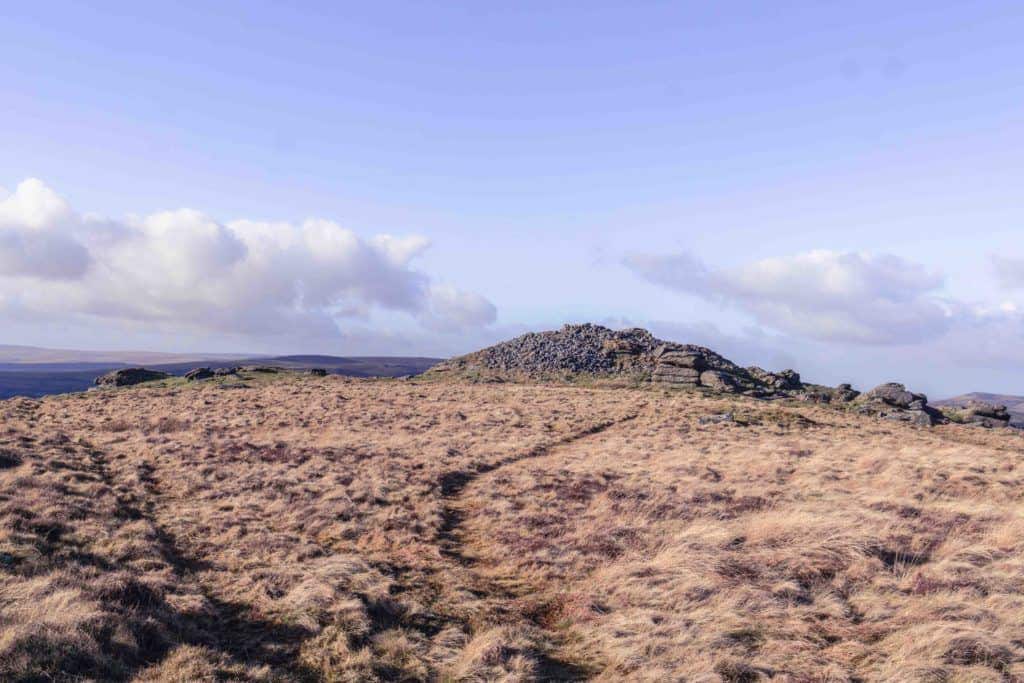
Visit Rippon Tor Rifle Range
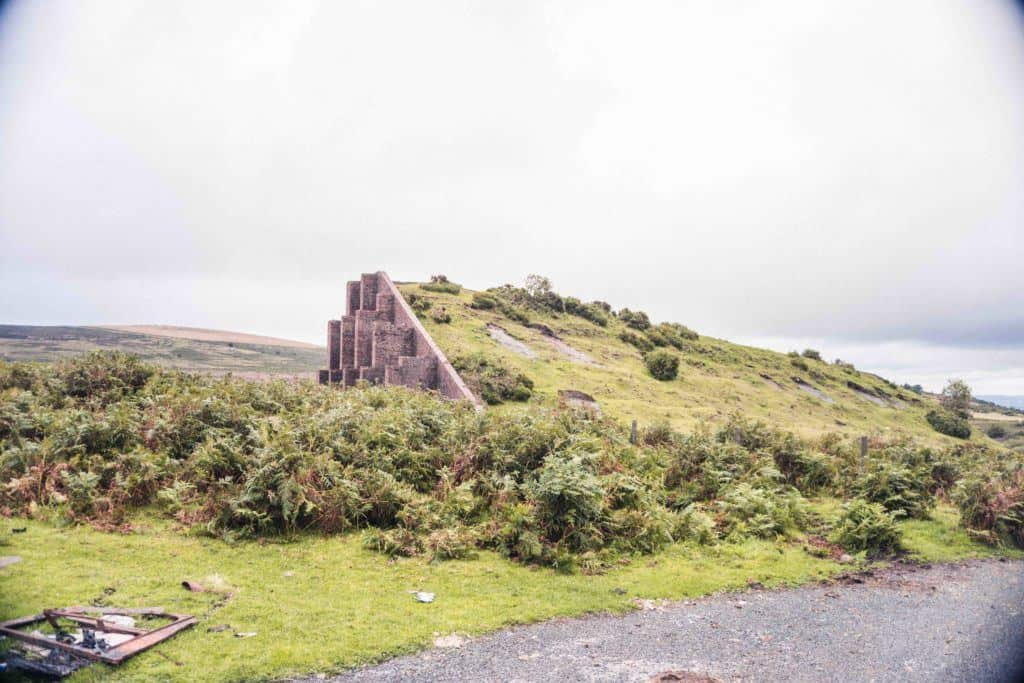
A bygone of an era gone by, Rippon Tor Rifle Range rises up and above the barren landscape surrounding it. Nearby to the highest point in the local area, Rippon Tor, and not far from the quintessentially British village of Widecombe-in-the-Moor, it’s one of those hidden gems of Dartmoor that even the locals don’t know about.
During WWII, Dartmoor provided the perfect training ground for military personnel. After all, it has few inhabitants, a harsh and barren landscape, and is the perfect place to erect training grounds. Such was the position of Rippon Tor, that the decision was taken to build a rifle range a mile away, below its peak.
The range was constructed in 1942, and from the outset, the vast structure has divided opinion. Some say that the rifle range is impressive, while others call it an eyesore. Whatever the case, there’s no denying that this is certainly a feat of architecture!
Today, plenty of the military facility still exists, though much in a dilapidated state. There’s the range itself, a colossal construction comprising of 19 buttresses to the back and six to the side. The protected trench where the troops would have stood still stands with all of its military paraphernalia, as does the toilet block a little way down the hill!
We visited on a particularly cold winter’s day and the area was secluded and more than a little creepy, to say the least! While Rippon Tor Rifle Range remains one of the most intact examples of military history on the moors, there are definitely more interesting historical things to see on the moor if you’re looking to see a little history for yourself.
Hike Sharp Tor
If you’re looking to experience all the views with a smaller (and arguably slightly easier) hike than elsewhere on Dartmoor, then the walk to Sharp Tor on Yartor Down may well be the walk for you. Surrounded by ponies, flanked by forests, and with views onto the open moorland, it doesn’t get more iconic Dartmoor than this.
The name ‘Sharpitor’ is also a variation and is the name of two rock formations elsewhere on the moor. For the purpose of these photos and this walk, we’re discussing the Sharp Tor of Dartmeet and East Dartmoor.
The view from the top is all-encompassing; from the very summit of Sharp Tor, it’s possible to see Venford Reservoir, the Princetown Telegraph Pole and Dart Gorge. In the winter months, when the gorse and heather plants are not as overgrown, it’s often possible to spot the remains of stone hut circles dating back millennia.
Sitting at a height of 380m above sea level, it may not be the highest point on the moors, but it’s certainly not the lowest either! Plus, it’s also the setting for ‘Dartmoor Killing’ a thriller that’s set in the Poundsgate area and is currently available on Netflix if you’re based in the UK.
Go wild camping
Dartmoor is one of the few places in the UK where wild camping remains legal (in most of England and Wales, wild camping requires the landowners permission in advance). Growing up, I spent many happy weekends wild camping with friends across the park.
There is a code of conduct that you must follow, which you can find here. Update: as of 2023, the controversial decision was taken by the High Court to ban wild camping on much of Dartmoor.
Buckland Abbey
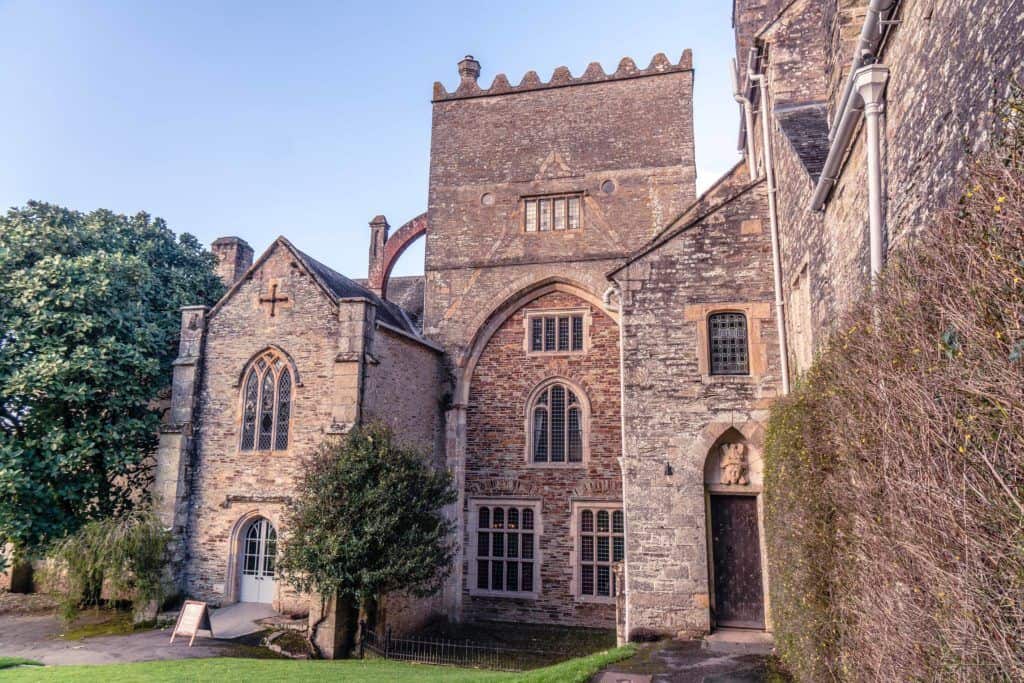
Located in a leafy copse at the edge of Dartmoor, Buckland Abbey has existed in some form or another for well over seven hundred years. As its name suggests, the Abbey was first founded by Countess of Devon, Amicia, in order to house Cistercian monks. Built in 1278, Buckland was the last of Cistercian Abbeys to have been constructed in medieval England and Wales.
However, in 1541 and with the dissolution of the Monasteries by Henry VIII (who formed his own church, the Church of England to bypass the Pope and enable himself to divorce his wife!) the abbey came under threat. The once religious building was taken over by the Royal regime and Henry VIII sold Buckland Abbey to Sir Richard Grenville the Older. Together with his son, Richard Greynvile the Younger, he converted the Abbey into a family home one room at a time.
The Abbey, now converted into a functioning family home, was in the Grenville family for just forty years. It was then sold to accomplices of Sir Francis Drake. This was because the Grenville family despised Drake and would never have sold to him directly. Although Francis Drake is often ‘celebrated’ as the First Englishman to circumnavigate the globe, he was actually an awful man by any account- slave trader, pirate, thief, murderer, politician, and knighted by Elizabeth I.
He lived at the Abbey for fifteen years until his death in 1596. Buckland Abbey then remained in Drake’s family for numerous generations before being sold to a local landowner. Following a fire in the mid-1900s, in 1948, the property was donated to the National Trust, who have cared and looked after Buckland Abbey ever since.
Visit Dartmoor and some very useful information
Fancy seeing more of Dartmoor? Well here’s information on where to stay in Dartmoor National Park, some of the best places to eat in Dartmoor and where to find plenty more information so as to make your trip as good as it can be!
Visitor Centres in Dartmoor
There are various visitor centres spread across the moors. These are designated information points where you can find out all sorts of useful information such as local walks, more history and important safety information. At many of the visitor centres across Dartmoor, you’ll also find public lavatories which are usually open during daylight hours throughout the year.
Haytor Visitor Centre (located in the bottom carpark as you look up towards Haytor Rocks). Haytor Vale, Newton Abbot TQ13 9XT
Princetown Visitor Centre (located in the very centre of the town, opposite the shop and next to one of the best Fish and Chip Places on the moors). Tavistock Rd, Princetown, Yelverton PL20 6QF
Postbridge Visitor Centre (located just up the road from the medieval Clapper Bridge of Postbridge). Car park on the B3212 Moretonhampstead to Two Bridges road., Yelverton PL20 6TH
Where to eat in Dartmoor National Park
Throughout Europe, and the rest of the world, the Westcountry in England is known for its fresh and locally sourced produce. And, of course, Dartmoor is no exception. Here are the best spots to eat on the moors!
Taylors, 5 North St, Ashburton, Newton Abbot TQ13 7QJ
Easily the best spot in Dartmoor to enjoy a cream tea (a regional specialty) and a perfect place to stop off for a break in between searching for treasure in the town’s antique shops. For more information, check out our complete Taylors of Ashburton review.
Primrose Tea Rooms, Lustleigh, Newton Abbot TQ13 9TJ
Often, after a long walk, you want nothing more than a hot drink and homemade cake. Well, the Primrose Tea Room in Lustleigh has all this, and a friendly atmosphere to boot!
Ullacombe Farm Café and Shop, Haytor Rd, Bovey Tracey, Newton Abbot TQ13 9LL
This little café is on the edge of the moors, pretty close to Haytor and is perfect for a quick stop. While here, you can also check out the farm shop which is filled with local produce you can purchase. Time to purchase a souvenir from your time in Dartmoor?
Where to enjoy a drink in Dartmoor (and the best pubs):
England is known for its pubs and those of Dartmoor are particularly spectacular. Many have breathtaking views from the windows, and some, such as the Warren House Inn have fires which haven’t been extinguished for decades! Read more: best pubs in Dartmoor National Park.
Warren House Inn, Postbridge, Yelverton PL20 6TA
This is the highest pub in the South of England and has a fire which has been burning perpetually for decades. Head here for the ambience and to enjoy a local drink (I wouldn’t head here specifically for the food).
Rugglestone Inn,Widecombe in the Moor, Newton Abbot TQ13 7TF
Quaint and quirky, the Rugglestone Inn is located around half a mile from Widecombe-in-the-Moor. This cute little pub is the perfect spot to head to after a hike up one of the nearby tors and to enjoy a cosy fire.
Where to Stay in Dartmoor (hostels, hotels, etc.)
Hay Tor Cottage
Widecombe in the Moor. This sweet little cottage is located just minutes away from the open moor and offers spectacular views over the surrounding moorland. Check prices and availability here.
Hamel Down Hideaway
Widecombe in the Moor. Situated next to a Grade II listed farm house, and is surrounded by an open garden. Check prices and availability here.
The Rock Inn
Haytor Vale. This pub and restaurant is located in the heart of Haytor Vale, a charming village with quick access to the moor. Check prices and availability here.
Enjoyed reading about the best things to do in Dartmoor National Park? Pin this article now, read it again later:




Thank you for the article. My ancestors, the Battishills (Americanized to Battershell), were from West Wyke on the northwest edge of Dartmoor. I don’t know if I will be able to make it there, but it’s nice to read this and dream!
Hey Sophie! Just a quick note to say this is fab, thank you very much for the info! Myself and partner Luke are heading off to Dartmoor for the second time today, and there are a few things we didn’t know about on here! Hopefully the weather holds up so we can explore loads 🙂 x
Thank you, I hope you both have a wonderful time!
Fantastic article 🙂 I’ve been thinking about hiking/wild camping around Dartmoor and this gives me the perfect itinerary, thank you!