

Auberge Nicolas Flamel: Alchemy & A Historic House in Le Marais
Last Updated on 29th January 2024 by Sophie Nadeau
This post may contain affiliate links. Please check out my privacy policy and disclosure for more information.
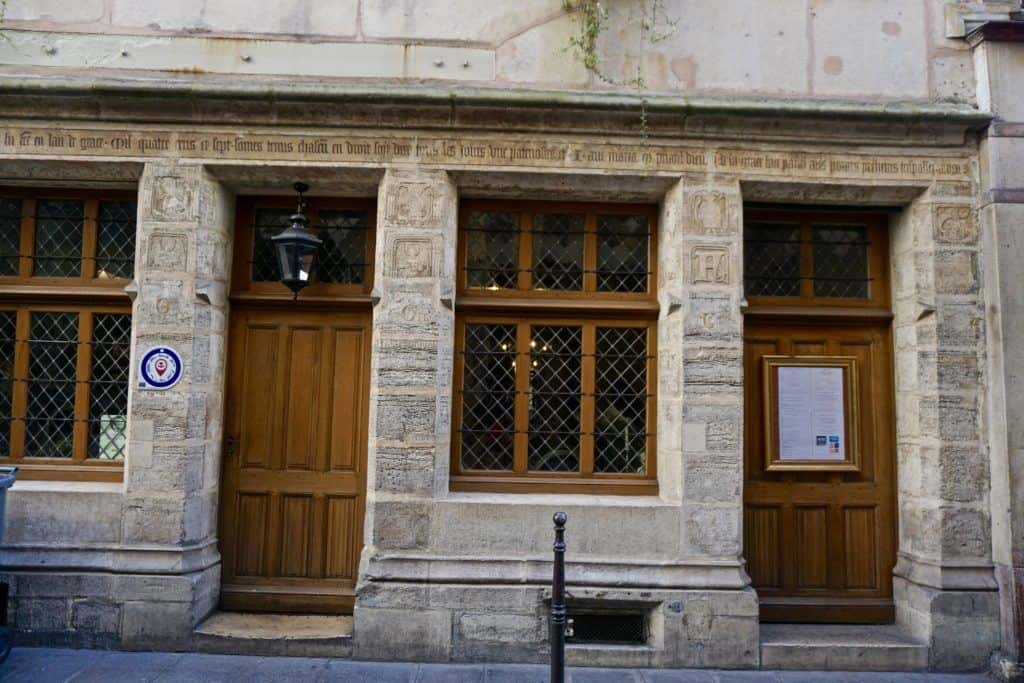
Deep in the heart of Le Marais, an area that largely escaped the Haussmannian renovations that saw the rest of Paris reconstructed during the 19th-century, you’ll find it. A small building, covered in carvings, and pretty insignificant in appearance. However, this is actually Auberge Nicolas Flamel, a former inn belonging to the acclaimed philanthropist and alleged alchemist and allegedly one of the oldest houses in Paris.
Contents
Nicolas Flamel and the Magical Connection
You may well have already heard of Flamel before. After all, centuries following his death, rumours began to circulate regarding whether or not he may have had more ties to alchemy than a simple dabble now and then.
Although Flamel has always been famous, what really sparked renewed interest in the Middle Age book vendor is the Harry Potter series. In the Philosopher’s Stone, Flamel is a key character together with his wife Pernelle and if you’re looking for the real-life Nicolas Flamel in Paris today, then here’s a quick guide!
It’s likely that JK Rowling truly got to grips with the real-life man and his history when she spent a year abroad in Paris during her time as a Classics and French student at Exeter University. Today, you can explore the magic of Harry Potter in Paris if only you know where to look…

A history of Auberge Nicolas Flamel (Maison de Nicolas Flamel)
Modern books aside, Auberge Nicolas Flamel has much of merit. Located on Rue de Montmorency, the building can be found in the 3rd arrondissement of the city. Places of interest nearby include Musée des Arts et Métiers, the Centre Pompidou art museum, Passage de l’Ancre, and the impossibly large shopping complex of Les Halles.
It’s said that the Auberge was built at the behest of Flamel, following the death of his wife of Pernelle, in 1397. Completed in 1407, the oldest stone house in Paris was originally intended to serve meals to those who needed it most and so Nicolas Flamel probably never actually lived there.

Today, the historic inn still has a stone exterior, while the interior is completed by exposed wooden beams and haphazard walls. In times gone by, the building was known as Le Grand Pignon (The Great Gable), owing to a large architectural feature that was removed during the early 20th-century World’s Fair in Paris.
During Flamel’s lifetime, he was a well-known philanthropist and it’s thought that he contributed to other inns like that of 51 Rue de Montmorency in other parts of Le Marais, as well as renovating churches throughout the city. His day job included scribe work and vending books.

How to visit Auberge Nicolas Flamel
As the auberge is now an eating establishment, the only way you can truly experience the traditional interior is by heading inside to eat! With this being said, you can stroll past the front entrance come day or night and enjoy the historic carvings to the street-facing façade.
Now designated a historic monument, the fine dining restaurant is open for both lunch and dinner on a daily basis. Though I haven’t personally dined at the restaurant (after all, the prices are a little on the expensive side!), the online reviews tend to err on the more positive side of things…

Rue de Montmorency
Rue de Montmorency itself is fairly pretty and medieval looking, making it well worth a wander along, if only to snap a photo (or two!) Named in the 18th-century for the incredibly wealthy Montmorency family who inhabited Le Marais during the Renaissance period, following the French Revolution the street was known as rue de la Réunion for a brief moment in time.
Today, the most famous addresses on the pretty Parisian street include the site of a former print shop, as well as a location (now No. 5) where Nicolas Fouquet once resided. For those unfamiliar with the Superintendent of Finances for Louis XIV, the short story goes a little like this:
Fouquet constructed the first truly baroque French château at Vaux-le-Vicomte. So beautiful was this building that Louis XIV (the Sun King and the ruler who went on to expand Versailles to the place it is today) grew jealous. He confiscated Vaux le Vicomte and locked Fouquet away for the rest of his life…

Enjoyed reading about the historic Maison de Flamel in the heart of Le Marais? Pin it now, read it again later:





Loved the history behind this story. I shall have to check it out the next time I’m in Paris.