
Mont Saint-Michel Guide: Best Things to Do, Hidden Gems & Essential Tips
Last Updated on 17th July 2026 by Sophie Nadeau
This post may contain affiliate links. Please check out my privacy policy and disclosure for more information.
If there’s one thing that you make sure you do in Northern France, then make it a visit to Mont Saint-Michel! Of all the UNESCO world heritage sites in France (and there are a lot!), Mont-Saint-Michel is probably the best known and easily the most impressive. The conical tidal island has a rich and varied history; making it the perfect French travel destination for culture and history lovers.
Mont-Saint-Michel is one of the most popular tourist destinations that France has to offer. All 2.5 million visitors who visit the site annually can’t be wrong! I mean, that’s more than the populations of Fiji and Cyprus put together!

Introducing Mont Saint Michel
Perhaps what is most controversial about Mont Saint Michel is in which French region the island is geographically and culturally to be found. While the Mount is technically in Normandy (when it comes to administration), a debate ravages as the mount lies on the border between Brittany and Normandy and many in Brittany (Bretagne in French) believe that Mont Saint Michel is culturally part of Brittany.
How long do you need at Mont Saint Michel?
In terms of exploring and visiting the abbey and its surrounding buildings today, Mont St Michel is pretty tiny and so can easily be seen over the course of a few hours (though visiting earlier in the day as opposed to later will ensure that you miss out on the heavier crowds that tend to flock to the island later in the day).
If you are visiting Mont Saint Michel as part of a day trip from Paris, then make sure that you leave early in the morning, giving yourself plenty of time to see everything that the island and its surrounding bay has to offer.
Not only is it possible to visit the abbey, but there are also many streets to explore, the bay to see, a few small (yet touristic) museums and an old part of town, complete with timber-framed houses. Oh, and whilst there make sure not to miss the cider that the region is famous for!
Most of the restaurants in town serve pretty mediocre fare at high prices and so I would highly advise bringing along a picnic, even if there are few places to sit and eat one! Both times I’ve visited the tidal island there has been no rain forecasted and yet we still experienced brief showers.
Best time to visit Mont Saint Michel
As one of the most visited monuments in France, it should come as no surprise that the place is always packed! However, the majority of tourists visit in peak season: July and August. If you want to somewhat avoid the crowds, then avoiding the island during these months is advisable.
Furthermore, local hotel prices, both on the island and on nearby mainland France fluctuate wildly depending on the season. Visiting Mont Saint Michel in the shoulder seasons, or even during the off-season will save a lot of money in terms of accommodation, and perhaps time as there is a lot less traffic around the area!
A history of Mont Saint Michel
When it comes to the history of Mont Saint Michel, it’s worth noting that though the area where the Mont is now located has been inhabited since time immemorial, the site first became a place of pilgrimage during the 6th or 7th century when an Irish hermit started gathering a following from the local community on the Mount.
For over 1000 years, the island has been home to a monastery for which the island is named. The island itself has been inhabited for much longer and is of strategic importance to the French coastline. Mont Saint-Michel even appears in the Bayeux Tapestry…
From the 9th century, dukes from Normandy supported the monks in the local area to build an abbey on the elusive island, dedicating it all the while to the glory of God. Soon enough, the island gained Europe-wide fame as a place of pilgrimage and a centre for learning.
During the 12th century, there was a renaissance in France. This ‘original’ renaissance period has since been forgotten in light of the more recent one. But at the time, Mont-saint-Michel was a hive of activity and one of the greatest hubs of learning in Europe.

Illustrators and manuscript creators from all over Europe converged on the mount throughout the centuries to share a love of learning. Luckily for us, the monks here preserved many works of art and pieces of literature that exist nowhere else to this day. Without the monks, scribes, and illustrators that lived on Mont-Saint-Michel, much of what has been passed onto us would otherwise have been lost.
The same order of monks who built the fortress also created the church atop of Saint Michael’s Mount in Marazion, England, meaning that this site is inextricably linked to the Westcountry in England. I spent years living in South-West England so I love this personal historical link to the island!
During the French revolution, the island was used to house prisoners of the French revolution.In 1979, the site was made a UNESCO world heritage site, officially cementing the importance of this small chunk of land, a couple of kilometres from mainland France.
Is Mont St Michel a tidal island?
The conical structure sits atop of a tidal island, meaning that a couple of times a day when the tide comes in, the island is completely cut off from mainland France- well, almost. Surprisingly, silt has built up around the island over time.
This is both as a result of local farming on the mainland and the addition of the bridge linking the island to the mainland. As a result, there is now a constant battle to ensure that Mont-Saint-Michel remains a tidal island, and does not become just another part of the Northern French coastline!
Gothic, imposing, and often said to be the most photographed of all French destinations, Mont Saint Michel is one of the most breathtaking places you’ll ever lay your eyes on, should you be lucky enough to see the conical tidal island and abbey for yourself. But despite attracting some 2.5 million visitors on an annual basis, there are still several hidden gems left to uncover. Here’s your guide to the best of secret spots in Mont Saint Michel…
Église Saint-Pierre, Le Mont-Saint-Michel
Located along the main thoroughfare which snakes its way up the tidal island, the parish Church of Saint Peter is free to visit and is a true feast for the eyes. Sumptuously decorated, you’ll know you’re in the right place when you spy the short tower and a statue of Joan of Arc guarding the main doorway to the ecclesiastical building.
The church itself predominantly dates all the way back to the 14th, 15th, and 17th centuries, and since the 19th-century has served the purpose of both parish church for the commune of Mont Saint Michel (there are around 50 full time residents on the island) and as a sanctuary for pilgrims.

Funerary slabs outside Église Saint-Pierre
If you step outside the back entrance to Église Saint Pierre, then you’ll spy some ancient and historic tombstones mounted vertically on the steps which lead from the church to the island’s cemetery (to the west side of the church). There are five funerary slabs in total.
These are thought to be the remains of tombstone markers from the first quarter of the 17th-century. Rathe interestingly, repair work carried out in 2017 also revealed that, during medieval times, Mont Saint Michel cemetery, once extended to a radius of 30 metres surrounding the Church of Saint Peter of Saint Michel.

Cimetière du Mont Saint-Michel
One of the lesser-frequented hidden gems of Saint Malo is the tiny walled cemetery which can be found around a third of the way up the tidal island and directly outside of the church of Saint Peter. The site has been classed as a historical monument since 1934.
Due to its precarious position on the hillside, the cemetery is set over two terraces, though one of the two is so steep and thin that it can only accommodate five graves. At the most southerly point of the cemetery, a memorial garden has been incorporated into the graveyard. While you’re visiting this peaceful spot, be sure to look up; it’s from here where you’ll be rewarded with one of the most striking and breathtaking viewpoints of the abbey.

La Tour Gabriel
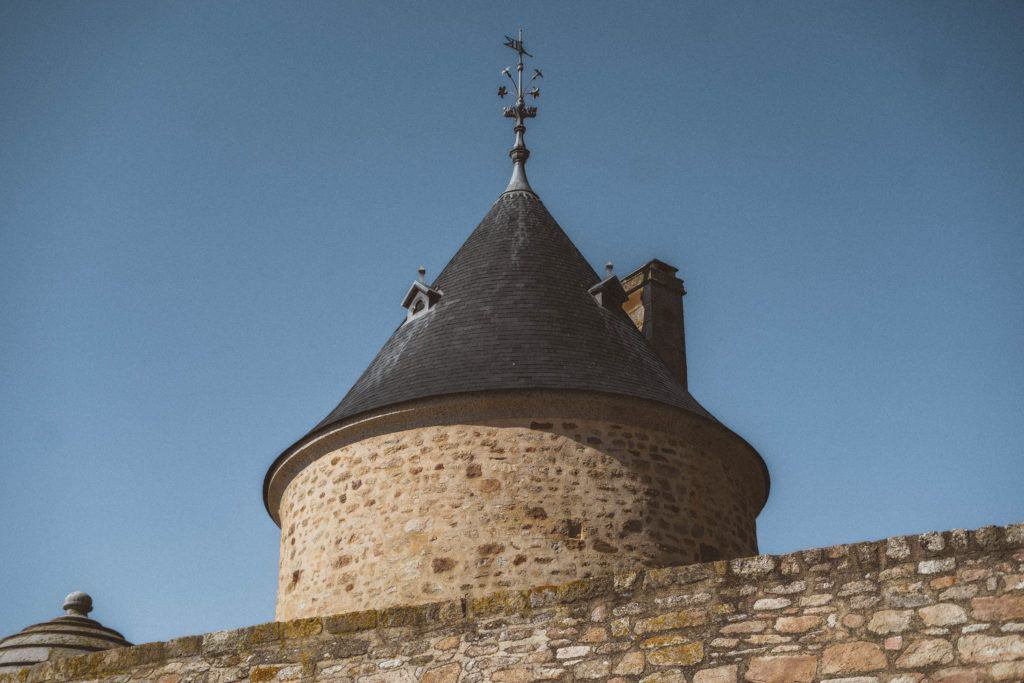
Upon entering the main gate to the citadel, take the path that goes to the left. Though it may seem like you’re headed away from the shops and many of the throngs of tourists who seem to congregate at the base of the mount, you’ll be headed towards a solitary and less frequented spot, making La Tour Gabriel one of the best secret spots in Mont Saint Michel.
Constructed in the 16th century at the behest of Gabriel du Puy, the tower was constructed so as to serve as a defensive base for the western side of the tidal island. Once upon a time, the building would have housed canons set over three floors, which could fire in multiple directions. Though you can’t visit the interior today as a member of the public, La Tour Gabriel remains fascinating itself to enjoy from the outside.
Chapelle Saint Aubert
Located on the edge of the island closest to the sea, Chapelle Saint Aubert is at the very last point where the crashing waves meet the rocky land and is a true sight to behold. Situated on the most North Westerly tip of the tidal island, the chapel of Saint Aubert finds its roots as far back as the 12th-century and is built in the Romanesque style.

Ley Lines
Last but not least, it’s well worth noting the subject of ley lines, along which Mont Saint Michel (as well as the younger sibling, Saint Michael’s Mount in Cornwall England, which was built by the same order of monks as the French version) is alleged to lie.
One ‘ley line’ theory suggests that, throughout the world, there are hidden energy lines circumventing the globe and directing their power into the earth. Some people go so far as to suggest that they are the earth and the driving force behind it.
Ley lines, song lines, dream paths and energy lines; cultures thought the world have a plethora of names for variations of the ‘ley line’ description. What is truly interesting is that it would seem that almost every culture has a concept of this ‘energy line’.
Mont Saint Michel is alleged to be along the ‘Saint Michael’s Line,’ which is a ley line connecting monasteries dedicated to the Archangel Michael in Europe and the Middle East. Though not a ‘hidden gem’ so much as a theory, ley lines are yet another mystery surrounding Mont Saint Michel nonetheless.
Practical tips for visiting Mont Saint Michel
Purchase your Mont Saint Michel tickets in advance
If you want to save precious time during your visit to the ancient Abbey, then I recommend purchasing your Mont-Saint Michel tickets well-ahead of your visit. This way, you’ll make the most of your time at the Mount, without having to waste precious exploration time by waiting in extra queues!
Be cautious about the tides
A word of warning: crossing to Mont Saint Michel on foot, across the sandbar is incredibly dangerous and not recommended. Tidal surges can occur and have been known to happen. Also, a local waterworks regularly empties water into the area, making water surges all the more likely. Oh, and did I mention that there’s quicksand? So, use the bridge, which is both safe and free to use!
Bring warm clothes (I’m talking coat and scarf as a minimum!)
As I learned, much to my dismay, just because you’re visiting the Mount in August doesn’t mean that the weather will be good! Bring warm clothes with you as the tidal nature of the island, as well as its precarious position along the coastline, means that Mont Saint Michel is often cold, even when all other areas in the region seem relatively mild and warm.
Visit the Mount early in the morning (or late at night!)
Not only will you get the best lighting if you visit closer to one of the day’s golden hours, but you’ll avoid much of the crowds which flock to the island during the day. Visit early in the morning if you wish to see the interior of the abbey, and visit later in the day if you’re not so bothered about seeing the abbey’s decor but still wish to miss many of the tourists. A late night jaunt to the castle will also ensure the best of both worlds, enabling you to see the castle both in the day, and the iconic way it is lit up by night.




Such a fantastic place! Thank you for the tips and photos! I look forward to visiting!
xo
Stella
http://www.stellaasteria.com