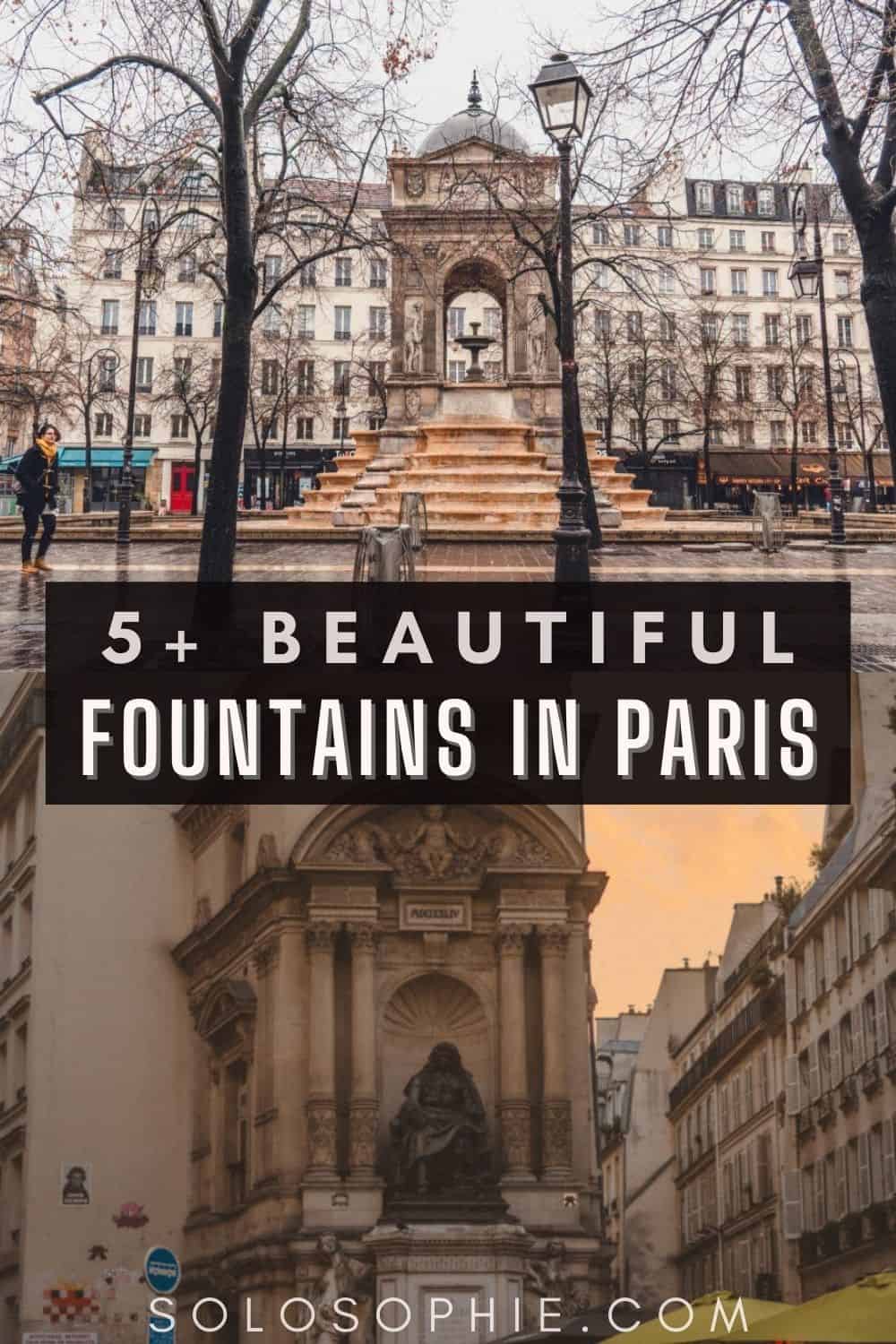

The Most Beautiful Fountains in Paris: From Hidden Gems to Iconic Wallace Fountains
Last Updated on 17th July 2026 by Sophie Nadeau
This post may contain affiliate links. Please check out my privacy policy for more information.
As a city with countless monuments, vistas, and landmarks, many visitors to the French Capital are so in awe of everything that the City of Light has to offer that they miss out on noticing the little details, such as the many fountains in Paris that are also worth checking out. Here’s a guide to the best and most beautiful fountains in Paris.
Please note that the Wallace Fountains are the only fountains in Paris which provide certified free drinking water.

How many fountains are there in Paris?
Many people associate Paris with Haussmannian architecture but the missing piece of the puzzle are the sheer number of ornate fountains that there are, scattered across the city. There are over 200 fountains, with the oldest dating all the way back to the 16th-century!

Most beautiful fountains in Paris
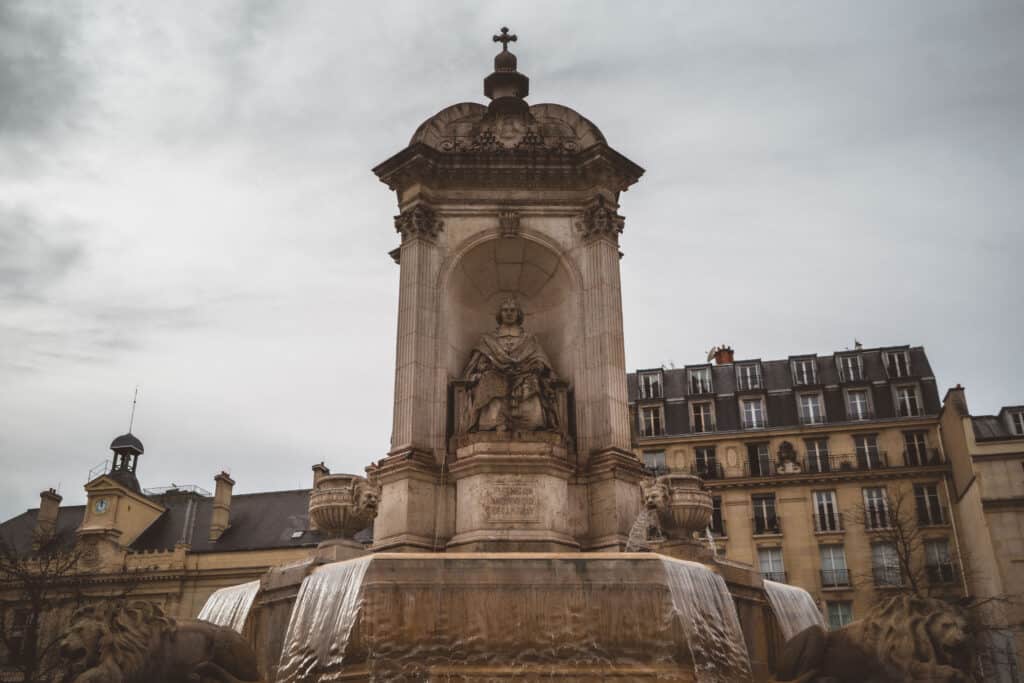
Fontaine Saint-Sulpice
Steps away from the Jardin du Luxembourg, the stunning neo-Classical Saint-Sulpice church is one of the largest ecclesiastical buildings in the city.
Directly in front of the main façade of the church, there’s a large public square where many people head to in order to meet their friends, soak up the sun, and enjoy lunch breaks.
In the very heart of this public square, it’s hard to miss the Fontaine Saint-Sulpice, which towers above the rest of the area at a staggering 12 metres.
Also known as Fontaine des Orateurs-Sacré, indeed the fountain is so tall that people criticised it for blocking the church when it was first installed in the mid 19th-century.
Medici Fountain
Located just steps away from the Latin Quater (so-called because students of the nearby Sorbonne university would converse with one another in Latin during the middle ages) and just minutes away from the Paris Pantheon, the Jardin du Luxembourg is where all the locals come to hang out come the warmer months.
After all, this park is not only home to the iconic green chairs that you find dotted around the city, but also several ornate fountains, chalets vending hot drinks and snacks, and several tennis courts. There’s even a secret Statue of Liberty tucked away in the Western corner of the park.
The Medici Fountain is the hidden gem of the garden, and one of the most beautiful places to visit in Paris. When it came to her new palace, one of Catherine de Medici’s main requests was that her gardens should have a monumental fountain, just like the gardens of Boboli in Florence. Cue: the Medici Fountain.

Fontaine Saint-Michel
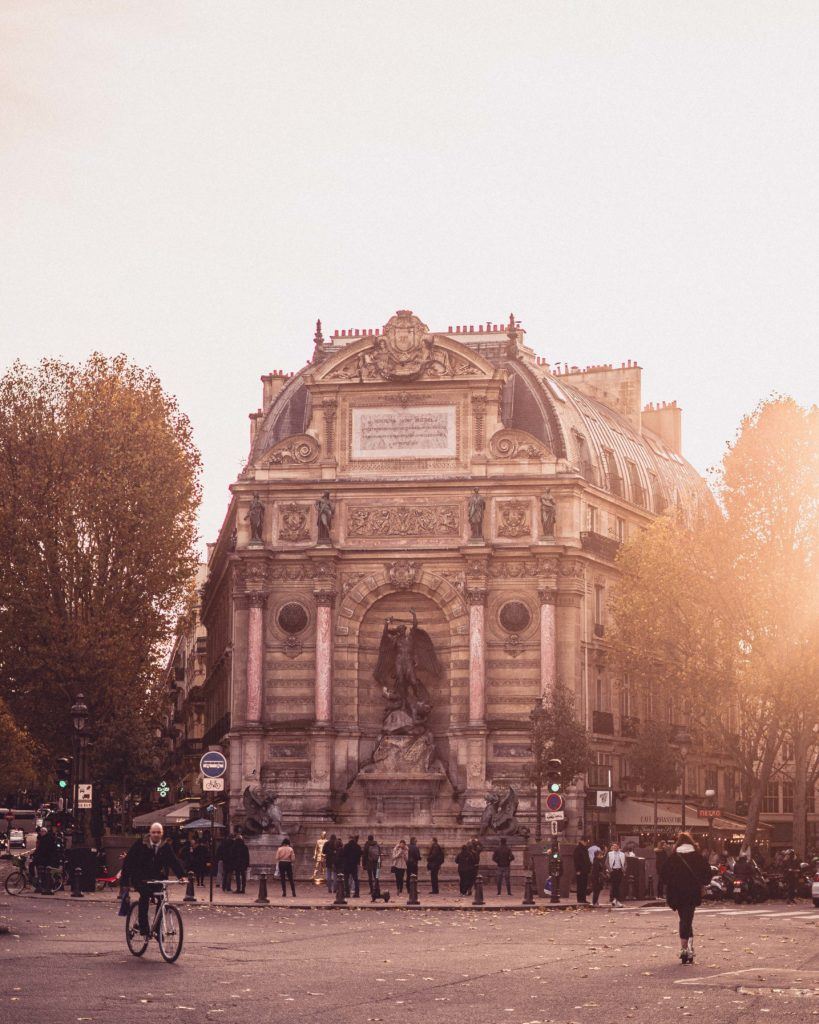
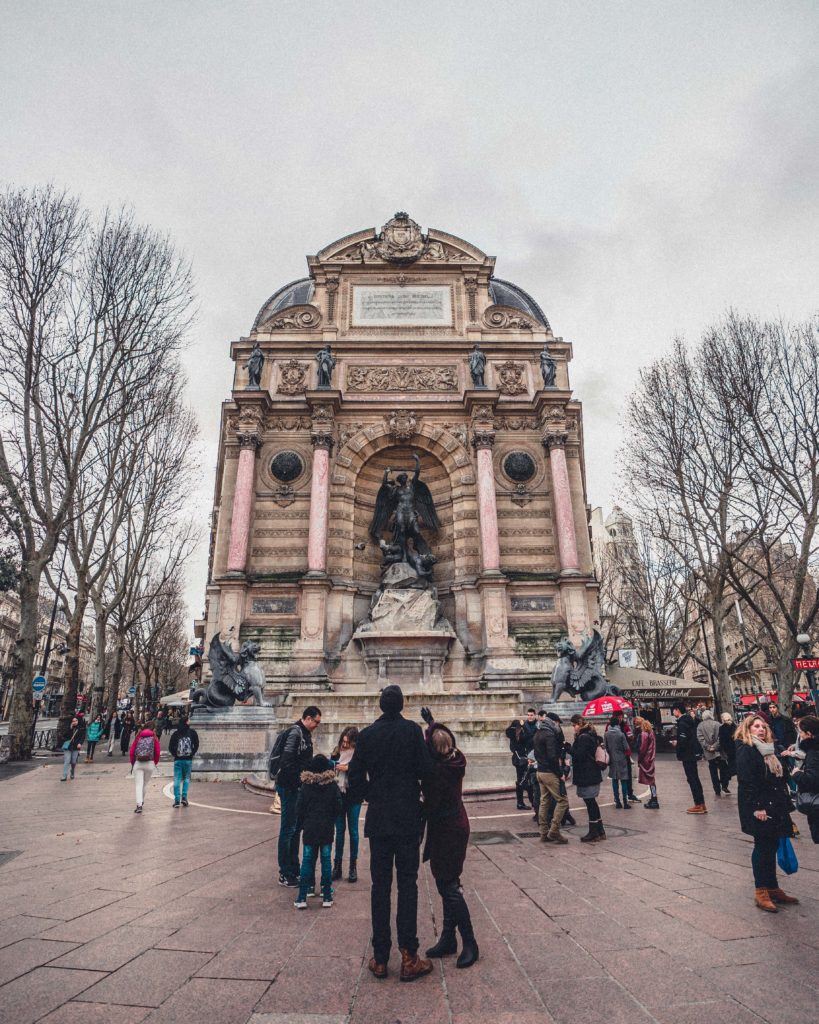
Standing at the intersection where boulevard Saint-Michel meets rue Danton, it’s hard to miss the carved and ornate Parisian fountain. After all, Fontaine Saint-Michel stands at a height of 26 metres and is 15 metres wide, making it one of the grandest fountains in Paris.
The water fountain is perhaps one of the ‘poster monuments’ of the grand overhaul of Parisian architecture undertaken by Haussmann during the 19th-century. Designed by Gabriel Davioud during the reign of Napoleon III, the French feature depicts archangel Michael vanquishing the Devil.
Within this, there are themes of good vs. evil and the like. However, what is particularly unique about this fountain (in perhaps all of Paris) is that it occupies an entire façade at the end of a block of Haussmann buildings.
In total, nine sculptors contributed to the creation of the Saint Michael fountain. Perhaps most notably, the central feature of Michael vanquishing the Devil was sculpted by Francisque Duret, a 19th-century artist whose other works of note include a bust in Avignon, a work in the Musée des Beaux-Arts of Lyon, and even a work of art in the Montréal Museum of Fine Arts.
Perhaps, rather controversially, the original idea was that the monumental fountain feature Napoleon I, much like many other acclaimed sites in the city today. However, this idea was soon abandoned and instead the Archangel theme was decided upon in order to commemorate a chapel dedicated to Saint Michael which had once stood in situ.
Critics disliked that the statue was set against a wall, they disliked that eclectic style (Corinthian columns paired with the polychromatic nature of the materials used), and they disliked composition.
Despite what people may have thought at the time, the fountain is here to stay and marked the end of a period of Renaissance style fountains in Paris, which all began with the Medici Fountain in the nearby Jardin du Luxembourg.
Today, the fountain can be found between the Latin Quarter and the Saint-Germain-des-Prés districts of the city. In popular culture, Fontaine Saint-Michel has most recently featured in the popular Netflix series, Emily in Paris.

Fontaine des Innocents
Impressive and grand, the oldest of all the public fountains in the 1st arrondissement is that of the Fontaine des Innocents. And despite a name like ‘Innocents,’ the location where this fountain can be spied (in the heart of the first arrondissement) hides a rather murky past.
After all, though Place Joachim-du-Bellay may be filled with eateries and people relaxing today, the square was once the site of a centuries-old cemetery, the Cimetière des Innocents.
During the time of the fountain’s construction between in the middle of the 16th-century, the French Renaissance feature would have dominated the surrounding area. Originally called the ‘Fountain of Nymphs,’ the design is the brainchild of Pierre Lescot (who worked on the Louvre).

Fontaine Louvois
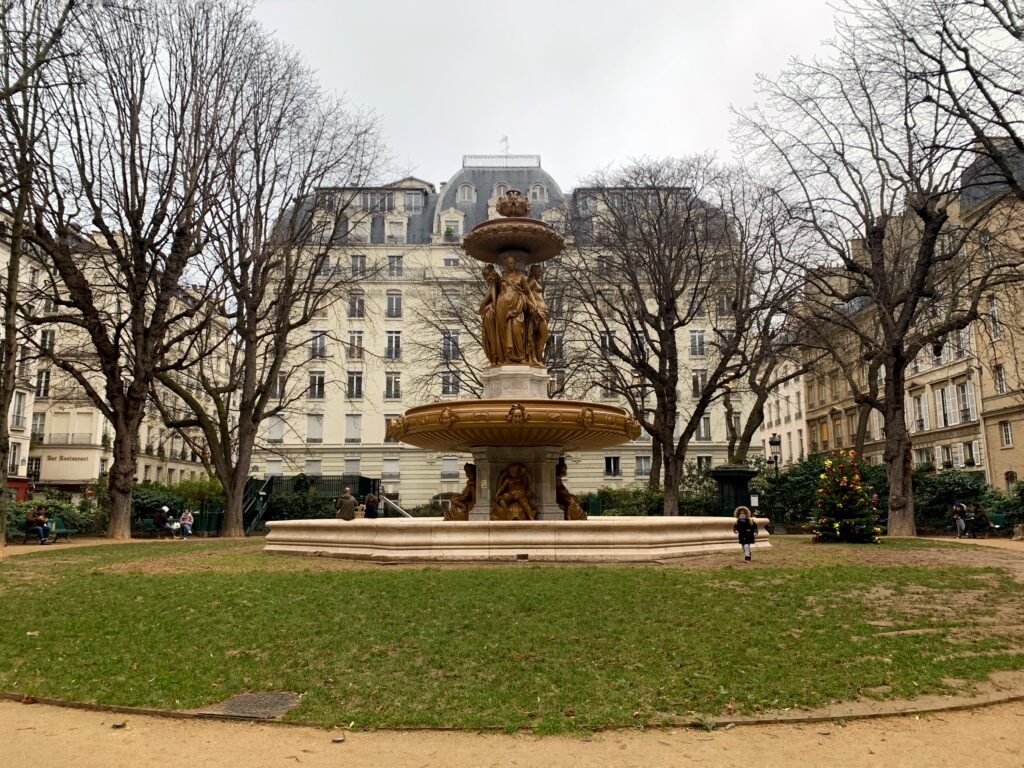
If you’re a fan of Gossip Girl, then you may well recognise the Fontaine Louvois (Louvois Fountain) as it featured in the episode where Blair pushes Serena into the fountain. The impressive monument can be found in the second arrondissement of the city and was constructed between 1836 and 1839.
Today, the fountain can be found in a pretty square of the same name, Square Louvois, which is a quiet square away located on the former Théâtre National de la rue de la Loi and is a hidden gem away from the hustle and bustle of the crowds of the city. Home to a number of benches, it’s the perfect spot to read a book or enjoy a quiet lunch.
Fontaine De Théâtre Français
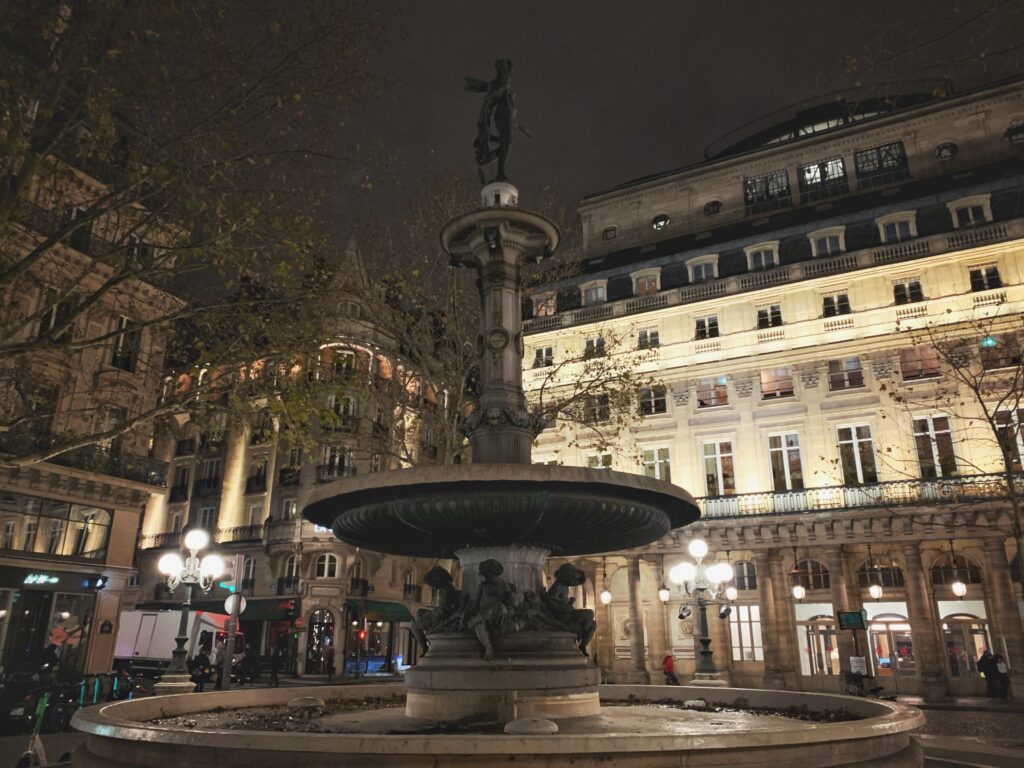
Though not quite as monumental or significant as some of the other fountains in Paris listed here, the Fontaine De Theatre Francais can be found right next to Palais-Royal, meaning that you’ll likely see the water feature, even during the briefest of Paris visits. The fountain was created between 1867 and 1874.
Fontaine de Mars
Located in the 7th arrondissement on the left-bank (Rive Gauche) of the River Seine, the Fontaine de Mars is a free-standing fountain that was created in the early 1800s in the neo-Classical style. Sometimes this Parisian fountain is also referred to as fontaine du Gros-Caillou.

Fontaine Molière
Situated in the illustrious first arrondissement of Paris, not far from the Palais-Royal gardens, the Fontaine Molière is one of the most beautiful water features in Paris.
Situated at the fork in the road where rue Molière meets rue de Richelieu, the fountain has been in situ since 1844. Previously on the spot, passersby would have seen the fontaine Richelieu, right up until 1838 when the fountain was demolished so as to allow traffic flow to more easily pass by.
What makes this water feature particularly notable is that it was the first publicly funded monument to have been created for a non-military figure. The fountain was designed by several different sculptors in artists, with its crowning jewel being a bronze depiction of a seated Molière.
The architect who was in charge of the project was the same architect who designed the grand monumental water feature in front of the church of Saint Sulpice, not far from the Jardin du Luxembourg.
Two small sculptures of females also appear on the fountain, with one representing ‘serious comedy’ and the other representing ‘light comedy’. Though he used Molière as his stage name, the writer’s actual name was Jean Baptiste Poquelin and he was born in Paris in 1622. Molière was best known for his works such as Misanthrope, Tartuffe, and The School for Wives, many of which are still performed to this day.
So influential was his work, that he is often considered to be the father of the ‘Comédie-Française’. Molière suffered from tuberculosis and actually died a few hours after a haemorrhage during a performance where he played the part of a hypochondriac Argan.
Just a few numbers down the road from the Molière fountain, along rue de Richelieu, you can see the location where the house where Molière died was once located. There’s a fairly large plaque on the building and so it’s easy to know you’re in the right place.

The Wallace Fountains
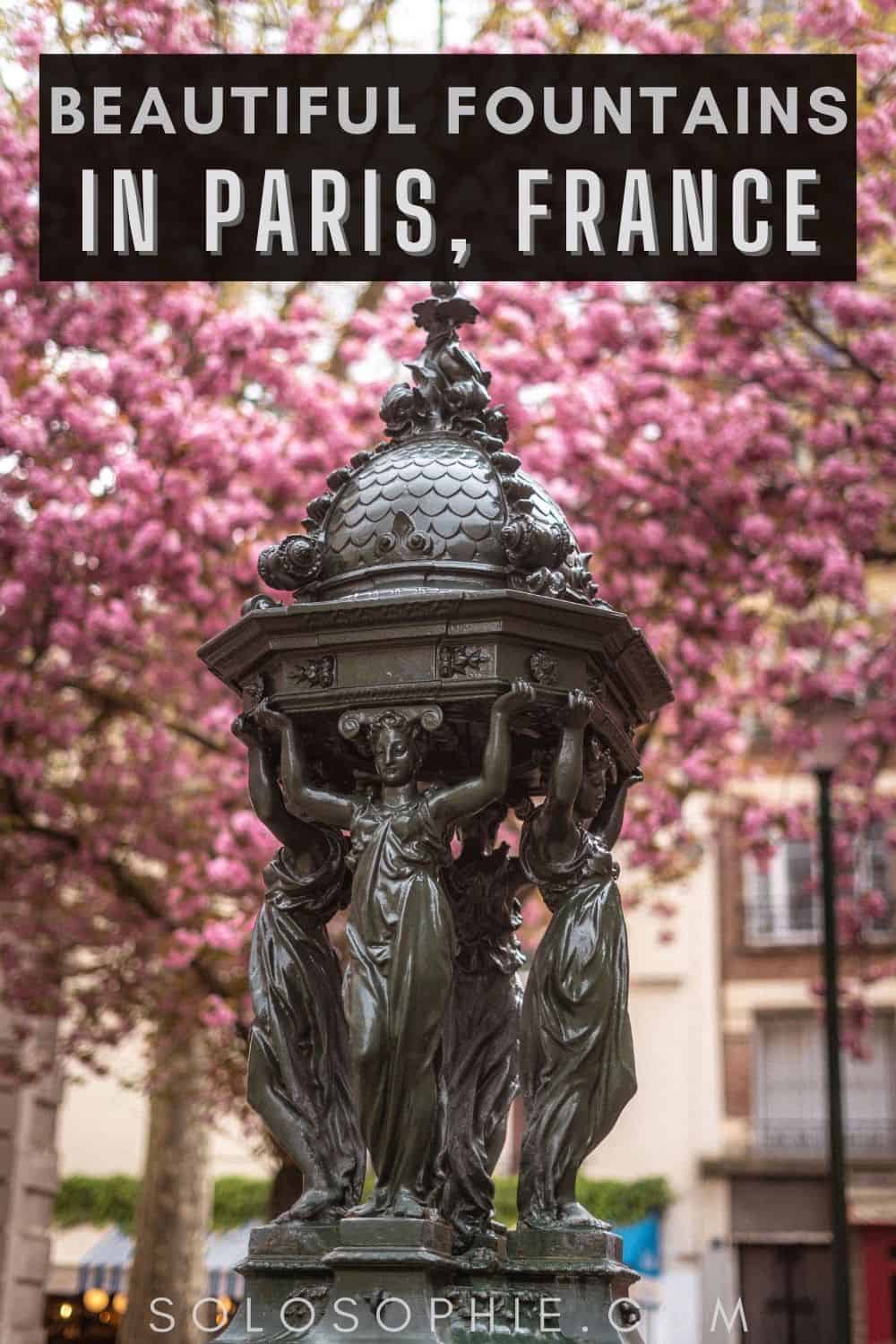
The Wallace Fountains of Paris are as essential to the landscape of Parisian architecture as the Arc de Triomphe but are often not thought of as such.
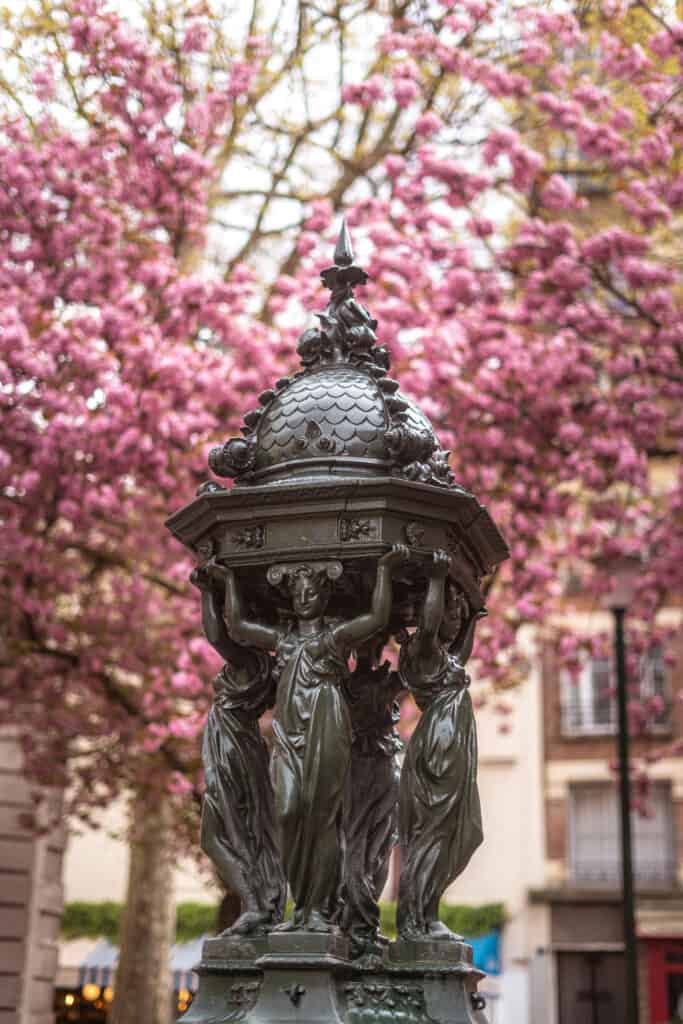
Dotted across the city and designed in the 19th-century, the fountains are characterised by their green cylindrical sculpted appearance.
Unlike many other water fountains across the city, these fountains are designed as drinking fountains and have distributed free and clean drinking water to the people of Paris for around 150 years.
As you might have guessed from their name, the fountains are named for Englishman Richard Wallace. There are four designs for the fountains, two of which features the four caryatids, the other being a lower water pump style of design.
A history of the Wallace Fountains
The history of the Wallace Fountains in Paris dates back to the 1870s. Following the Franco-Prussian war, the city of Paris was badly damaged. Parts of the city, such as the Palais-Garnier Opera house, Boulevard Raspail were swiftly transformed and rebuilt over the course of a decade.
During thisntome, the idea of ‘philanthropy’ became ‘fashionable’ amongst the bourgeoisie of French society. One such person who was known for being particularly generous was Sir Richard Wallace, an art collector and Englishman living in Paris.
In August of 1870, Wallace inherited a fairly substantial sum in inheritance from his father, which he decided to pay forward to the people of Paris. As well as creating the Wallace Fountains, Wallace also constructed a hospital in Paris and is now buried in Père Lachaise Cemetery.
As a direct result of the Franco-Prussian war, many of the aqueducts delivering water into the city were destroyed. The price of water soared to an all time and access was incredibly limited to those who most needed it.
The very first fountain was unveiled to the public in August 1872 and was an immediate success. The location of the fountains was of the utmost importance and this was delegated to Eugene Belgrand, who was Director of Water and Sewers of Paris.
Unique features of the Wallace Water Features
As mentioned, there are four different designs for the fountains. When it came to designing the fountains, Charles-Auguste Lebourg, a sculptor hailing from Nantes, was appointed as the man for the job.
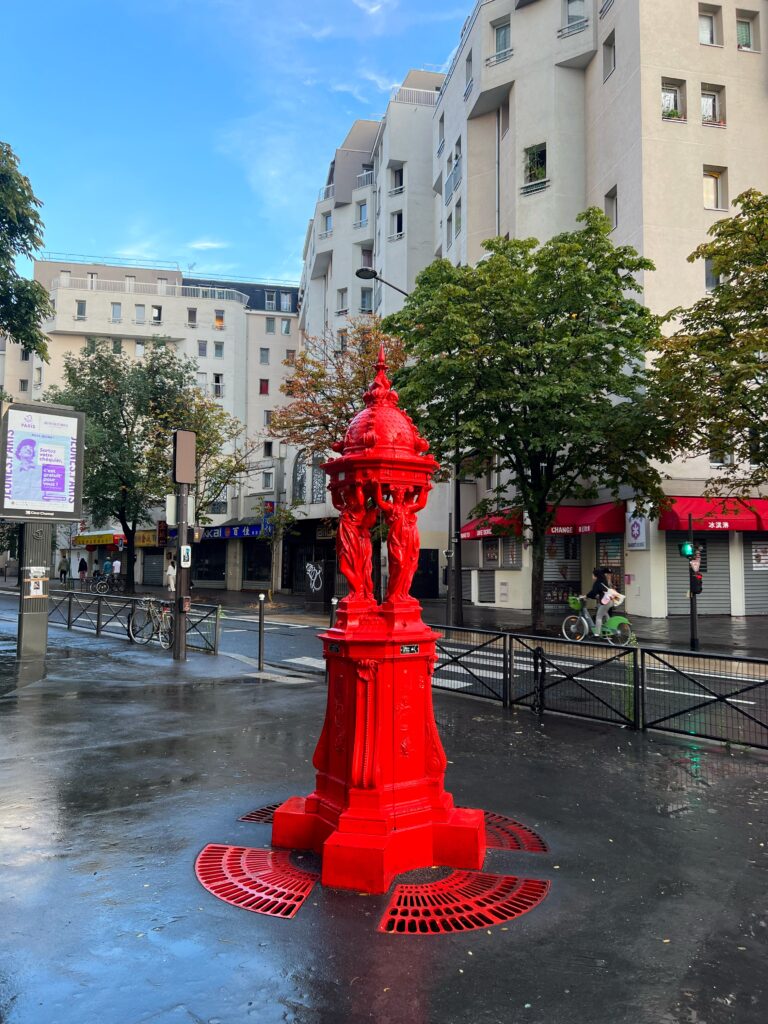
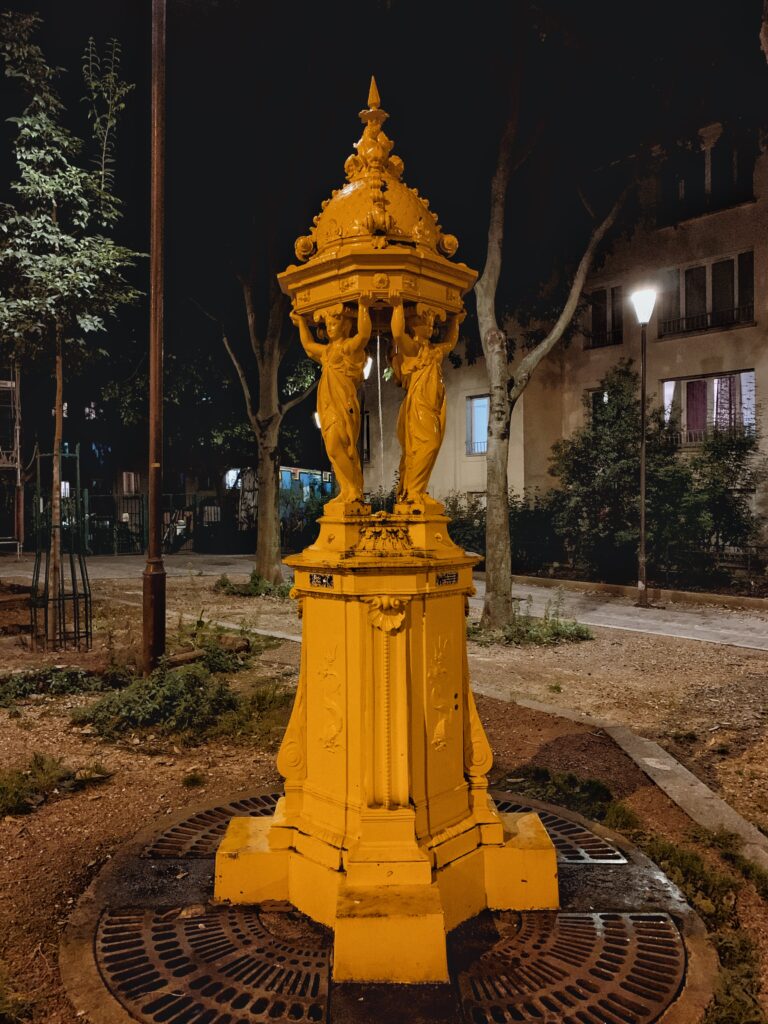
The colour green was chosen as it was determined that this would be the shade that would most blend into the Parisian landscape. Though the majority of Wallace Fountains still in existence remain a dark green colour, there are a few notable exceptions, including yellow, blue, and pink fountains.
Cast iron was chosen as the material for the fountains as this was relatively cheap to produce and was widely available. The fountains had to be high enough to be able to be easily spotted but not so high that they ‘ruined the harmony of the Parisian landscape’.
After all, even in time of desperate need, the bourgeoisie still considered Paris a place that needed to be ‘kept beautiful’. The form was meant to be both practical and aesthetically pleasing.
In total; there are four forms of the fountain, a large form, a wall mounted model, a small model, and the colonnade model (which is just a smaller version of the larger model with columns instead of caryatids).
How to visit the Wallace Fountains
Though some water fountains are located in parks which have open and closing hours, other fountains can be found along the side of the street. One such example that springs to mind is that of the fountain next to the Saint-Paul Métro station in Le Marais.
Today some Wallace Fountains even have soap dispensers installed so that you can easily wash your hands when out and about in the city.
If you’re particularly interested in learning more about Eau de Paris, then I really enjoyed the Zac Efron documentary on Netflix (the Eau de Paris features on one of the ‘Down to Earth’ episodes). Otherwise, you should know that, today, there are 103 Wallace Fountains in Paris.
So popular are the Wallace fountains, that they can now be found in several other cities and towns across l’Hexagone. These towns include Bordeaux, Nantes, Agen, Toulon, and Besanćon among other places.
Enjoyed reading about the most beautiful and best fountains in Paris? Pin this article now, read it again later: