
How the Mona Lisa Was Stolen from the Louvre in 1911
Last Updated on 10th July 2026 by Charlotte Nadeau
This post may contain affiliate links. Please check out my privacy policy and disclosure for more information.
The year is 1911. The first International Women’s Day has just been celebrated, George V has recently become King of the United Kingdom, and explorers are racing to become the first to reach the South Pole. It was also the year that one of the world’s most famous paintings vanished from the walls of the Louvre…
On 21 August 1911, Leonardo da Vinci’s Mona Lisa was discovered missing from the museum. News of the theft quickly spread around the world, leaving the public wondering who had taken the painting and whether it would ever be recovered. For more than two years, the mystery remained unsolved, becoming one of the most famous art thefts in history.

The Mona Lisa Mystery: A History of La Gioconda
Also known as ‘La Gioconda’ in Italian, the Mona Lisa is easily recognisable from her faint smile and Italian Renaissance style. Each year, millions of visitors from around the world flock to Paris to see her in pride of place at the Louvre museum.
Although many critics say that the Mona Lisa isn’t Leonardo’s finest piece, her rich history and the questions she raises have ensured that she has become one of the most- if not the most- famous paintings in the world. The Mona Lisa was painted by Da Vinci at some point in the early 1500s (the exact date remains unknown).
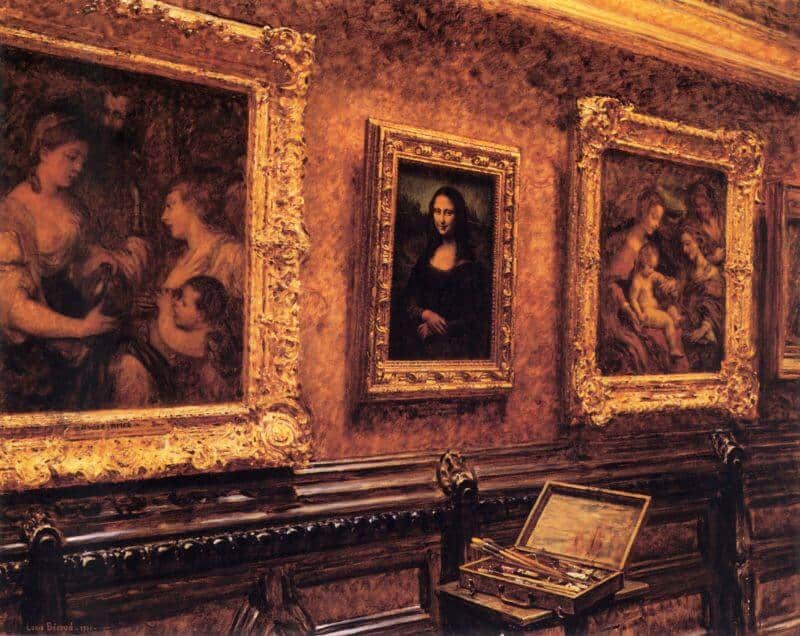
Although the exact date Leonardo da Vinci completed the Mona Lisa remains uncertain, most scholars agree that the sitter was Lisa del Giocondo (née Gherardini), the wife of Florentine merchant Francesco del Giocondo.
Over the centuries, however, many alternative theories have emerged, including suggestions that the portrait depicts an idealised woman or even Leonardo himself. While these ideas continue to capture the public’s imagination, they are not supported by the same level of historical evidence as the identification of Lisa del Giocondo.
Although no one is quite sure (believe me, when it comes to mysteries and the Mona Lisa, the uncertainty comes thick and fast), it’s thought that Leonardo brought the Mona Lisa with him when he was invited to Amboise by the King of France of the time, Francis I, in 1516. It’s thought that the King may well have purchased the painting from Da Vinci.
During this time, Leonardo Da Vinci is also thought to have designed much of Château de Chambord in the Loire Valley. From the time of the French Revolution onwards, the painting hung in the Louvre. Aside from when the Mona Lisa was stolen, and a brief stint when Napoleon hung the portrait in his bedroom, the Mona Lisa has remained in the Louvre ever since.
The Theft of a Generation: The Mona Lisa was Stolen
The Mona Lisa was already considered an artistic masterpiece long before 1911. Painted by Leonardo da Vinci, it was admired for its innovative technique, subtle expression and mysterious smile, and had been part of the French royal collection for centuries.
However, it was the theft of the painting from the Louvre that propelled it from a celebrated work of art to a global cultural icon. Newspapers around the world covered the story, and millions of people who had never heard of the Mona Lisa suddenly knew its name.
Indeed, the media coverage and journalistic storm that ensued following her theft ensured that the image of the Mona Lisa, and her faint smile, would remain imprinted in the public’s mind for eternity.
On 21st August 1911, the Mona Lisa was stolen from the Salon Carré in the Louvre.
The theft was only discovered the following day when a painter wandered into the Louvre to admire the Mona Lisa, and instead discovered four metal pegs! He promptly alerted security, who in turn alerted the media. However, even with worldwide searches, every lead came to a dead end. Pablo Picasso and Guillaume Apollinaire were both prime suspects(at one point, even Apollinaire was arrested and questioned!)
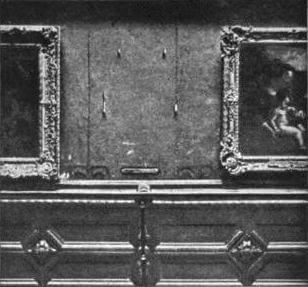
The Mona Lisa is found once more
For two years, the painting remained missing. With no leads and no security cameras (this was a time well before our every move was watched!), no one had a clue where the Mona Lisa could be. However, in November 1913, an art dealer in Florence was offered an undeniable request.
A man by the name of Leonardo Vincenzo (this would later turn out to be Vincenzo Peruggia) wrote to art dealer Alfredo Geri and offered him the Mona Lisa (for the eye-watering sum of 500,000 lire). Geri accepted the offer and Vincenzo travelled by train to Florence, with the Mona Lisa casually stuffed in his bag…
When he arrived in Florence, he booked into a hotel (which has since capitalized on this fact and changed its name to ‘Hotel La Gioconda’), and took the painting to Geri. The art dealer persuaded him to leave the Mona Lisa overnight and quickly alerted the police. The Mona Lisa had been found once more.
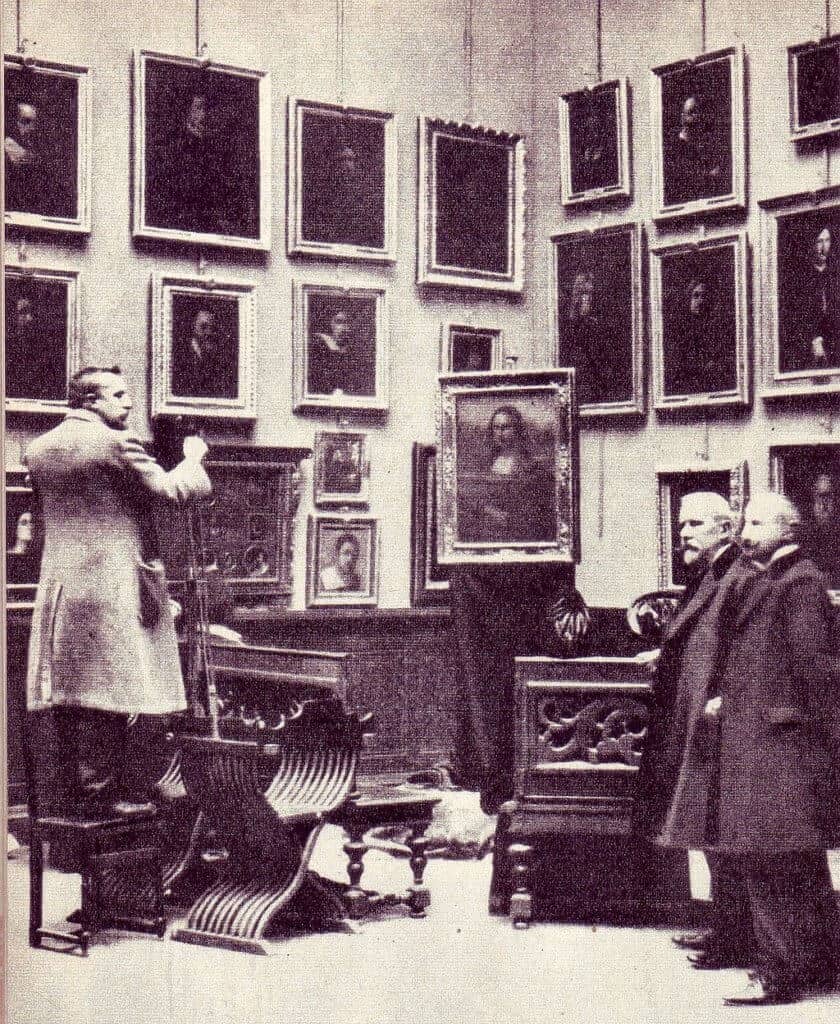
Mona Lisa in Italy, 1913
How did Vincenzo Steal the Mona Lisa?
It turns out, Vincenzo’s Peruggia’s simple plan was rather effective. Peruggia worked at the Louvre making protective cases for some of the museum’s most famous works. One day, he simply hid in a broom cupboard to avoid being thrown out at closing time.
During the night, Peruggia simply rolled up the masterpiece and hid her under his working smock. The next day, during daylight hours, he simply walked out of the museum with the masterpiece, seemingly undetected. In fact, as you’ve already read, no one even noticed until a visitor alerted the security team!
When the Italian was finally caught, he claimed that he had stolen the Mona Lisa in a bid to bring her back to her place of origin, Italy. He had mistakenly assumed that La Gioconda was stolen by the French and he was simply trying to return her to Italy.
When he was finally arrested, he was given a rather lenient six-month jail sentence. Many Italians thought of him a hero and when the painting was briefly on display at the Ufizzi Gallery in Florence (before its return to the Louvre), thousands flocked to see it.
Following Vincenzo Perguggia’s release from jail, he went on to serve in the Italian army during the First World War. After, he married and had a daughter. Later in life, he moved back to France in order to work as a painter and decorator (only this time, under his birth name, Pietro Peruggia). Peruggia died at just age 44, having made the Mona Lisa the most famous painting in the world.
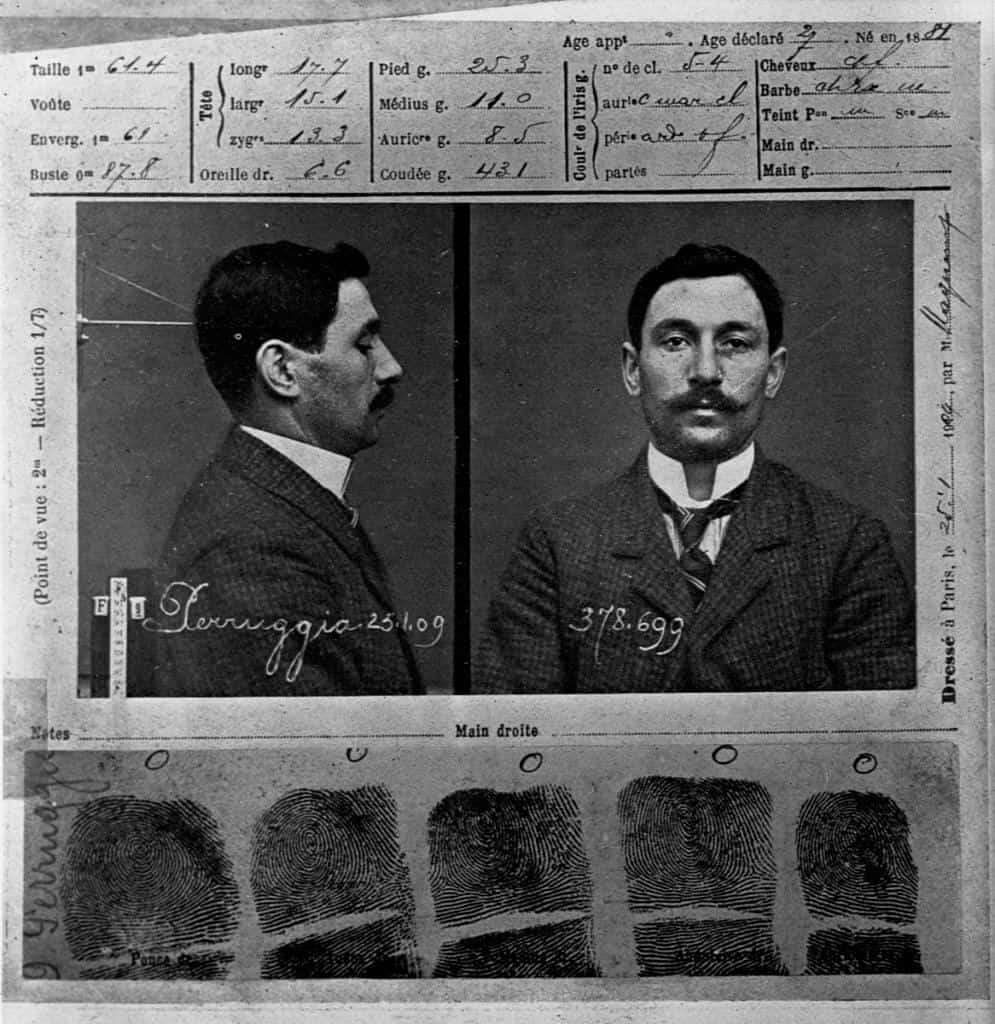
Vincenzo Peruggia, via Wikipedia
Is the real Mona Lisa even in the Louvre in Paris?
How can we be sure that the Mona Lisa hanging in the Louvre today (protected behind bulletproof glass!) is actually the original painted by Leonardo da Vinci?
Fortunately, there is little doubt among experts. The painting’s history has been carefully documented for centuries, while scientific analysis of the poplar wood panel, pigments and Leonardo’s distinctive techniques all support its authenticity. Taken together, the evidence leaves art historians confident that the Mona Lisa on display today is indeed the genuine masterpiece.
However, another earlier painting of the Mona Lisa exists, which is also thought to have been painted by Leonardo Da Vinci. Many now believe that Leonardo painted both copies of the Mona Lisa (the one in the Louvre being a later edition).

How to visit the Mona Lisa in Paris today
You should know before you go that the Mona Lisa is not the only painting in the Louvre. Instead, in an adjacent room to La Jaconde, other Da Vinci works on display include The Virgin and Child with St. Anne and the Annunciation. For more insider tips on visiting the Louvre, check out my Paris museum guide.
Of course, if you want to make the most of your time in Paris, then you’ll want to book your Louvre entrance tickets well in advance. For example, this Louvre timed entrance ticket grants access to a skip-the-line and oh so much shorter queue, allowing for more exploration time and the chance to save on some of your precious time in Paris.
Alternatively, if you’re looking for a more guided experience of the museum, then you might consider booking this Louvre Museum Skip-the-Queue Guided Tour. Finally, the Louvre is the largest museum in the world, and so even if you’re only planning to see the Mona Lisa, you’re sure to find something else of interest. After all, between Roman pottery and medieval crumbling foundations, the Louvre certainly has no shortage of things to see!
A note on the Salvator Mundi, Leonardo Da Vinci’s ‘other’ controversial masterpiece
Since 2017, the Mona Lisa being stolen hasn’t been the only controversial event to have befallen a(n alleged) Da Vinci work. You see, the Salvator Mundi, which is widely contentious in the art world as many experts don’t believe it to be a genuine Da Vinci, resurfaced after decades outside of the public eye.
The high-priced deception or ‘rediscovery of a masterpiece’ (depending on who you believe) was believed to have been created for King Louis XII and his consort Queen Anne. Having disappeared between 1763 and 1900, the oil painting was largely thought to have been destroyed or simply lost to the ages.
All this changed in 1900 when the painting was purchased by an English collector (Sir Charles Robinson) who believed the painting to have been the creation of a follower of Leonardo, Bernardino Luini. Once more, the painting was sold through auction at Sotheby’s in 1958 before re-emerging into the public conscience in 2005.
In 2017, the Salvator Mundi was once again sold at auction, this time as a work quite literally attributed to Leonardo da Vinci. Sold at Christie’s in New York, the piece fetched a staggering sum of $450,312,500, the highest ever record for an artwork.
The buyer remains anonymous and the painting has not been seen since. Though there were rumours that the artwork would appear at the 500th anniversary exhibition at the Louvre, it never surfaced, thus increasing the mystery surrounding the ‘Salvator Mundi’.
2022 Mona Lisa Cake Attack
On the 29th May 2022, a man alleged to have been dressed up as an older woman in a wheelchair threw a cake at the piece of glass which was installed to protect the Mona Lisa. He then smeared the glass with the cake.
A video posted on social media shows that he then shouted to people to ‘Think about the Earth. There are people currently destroying the Earth. Think about it. Artists tell you to think about the world. All Artists should think about the Planet. That’s why I did this’.
(In French ‘Pensez à la Terre. Il y a des gens qui sont en train de détruire la Terre. Pensez-y. Les artistes vous disent “pensez à la Terre”. Tous les artistes, pensez à la Terre. C’est pour ça que j’ai fait ça’). He then threw roses around the gallery. He was then escorted from the premises by Louvre security personnel. The man’s identity is currently unknown.
2024 Mona Lisa Soup Attack
Again, at the heart of another foodie attack and climate protest, in 2024, two environmental protesters threw soup at the 16th-century painting. And so, you can see that the Mona Lisa continues to capture attention worldwide…hence why she is the target of many an attack!
“The Louvre said that members of Riposte Alimentaire, which it described as an environmental movement, sprayed pumpkin soup on the painting at around 10:00 local time (09:00 GMT), and that there was no damage.” -BBC
While some viewed it as an effective way to bring attention to environmental concerns, others criticised the tactic, arguing that targeting cultural landmarks risks overshadowing the message and alienating the public.
Upcoming relocation (2031)
Recently, it was announced that there would be a “New Renaissance” overhaul for the Louvre. As part of this renovation, the Mona Lisa will be moved out of its current crowded gallery into a dedicated underground exhibition space by 2031… fingers crossed she doesn’t fall prey to another theft!
Enjoyed reading our guide on how the Mona Lisa Was Stolen from the Louvre in 1911? Pin this article now, and read it again later:


there is no way he “simply rolled up the masterpiece” as it was painted on a wood panel.
I am doing a research on Mona Lisa and this helped me thanks.
Wow, no wonder they keep the Mona Lisa so secured in the Louvre! (If it even is the real one)
We went to the louvre a few years ago and found the Mona Lisa a little underwhelming. And so crowded. This story makes it a little more fascinating. Thanks!
I never even knew that the Mona Lisa had been stolen! Such a fun read, Sophie! And beautiful research and content to pair!