

How To Visit The Scottish Parliament Building
Last Updated on 26th February 2025 by Sophie Nadeau
This post may contain affiliate links. Please check out my privacy policy and disclosure for more information.
Home to the Scottish Parliament, this controversial building once caused quite the outcry and blew a huge amount of the annual Scottish Budget. Today, it is one of the most unique pieces of architecture to visit in the city. Here’s how to visit the Scottish Parliament Building in Edinburgh, as well as nearby attractions to visit!
Contents
How much does it cost to visit the Scottish Parliament?
It’s completely free! To be honest, as a local who’s lived here for many years, I was too intimidated by the outside (and the fact it’s parliament) to see how to visit. However, after a recent trip here I can vouch for the fact it’s definitely worth a peek inside!
A brief history
The Scottish Parliament Building or as it’s known in Scottish Gaelic, Pàrlamaid na h-Alba, is home to the Scottish Parliament in Holyrood and sits within the parameters of Edinburgh’s Old Town, a UNESCO World Heritage Site.
The parliament building was built following the 1997 referendum which saw Scottish people vote in favour of having a directly elected Scottish Parliament to approve its own legislation. It was decided that directly opposite the King’s Scottish residence and below the iconic Arthur’s Seat in Holyrood, would be the location for the new political site.
To decide who would design the building, an International competition was held. Enric Miralles, a Spanish architect who graduated from the Barcelona School of Architecture, created the chosen design.
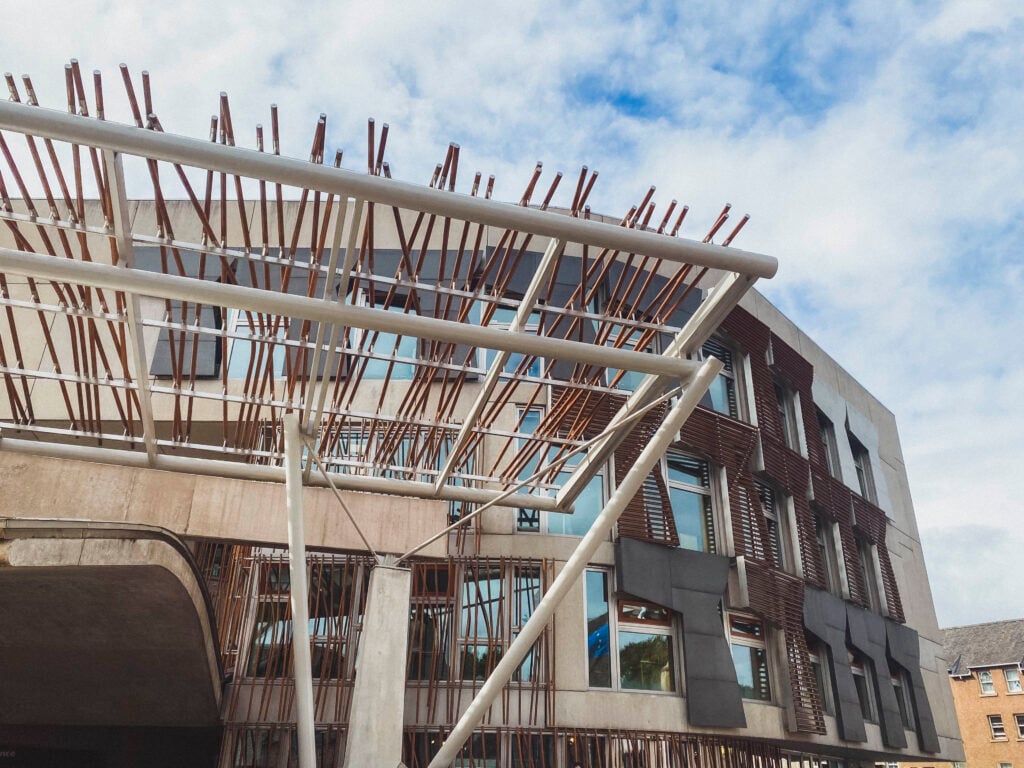
The idea for the branch-like building was to reference Scottish architectural history and mirror the natural landscape that sits just behind it, it also had the intention to be designed with sustainability. However, from the very outset of the building, even before its construction, the very idea and location choice caused much controversy in the media, by politicians and particularly by local residents.
The ambitious project began in 1999 and was set to be completed in 2001; however, many complications were run into along the way. The Scottish Parliament Building officially opened its doors in 2004, three years after it was expected. And, the initial costs (which were expected between £10m and £40m) ran over significantly, the overall project cost £414 million to build.
This caused a major public inquiry the following year and a an investigation into the handling of the construction was carried out. Despite the outrage, the parliament building has been welcomed by architect enthusiasts and it went on to win several awards. Sadly, Enric Miralles passed away in 2000 and never saw the completion of his design.
Today, the Scottish Parliament Building has melded into the city landscape and draws in the eye of those who pass by. The Scottish Government hold all of the important debates and meetings here, and on occasion, protesters will gather outside to put pressure on the government regarding certain world-issues.
How to visit
Opening times: 10 am – 5 pm Monday to Saturday & closed on Sundays
The Scottish Parliament Building is free to visit and open to the public. If you are heading from the centre of Edinburgh, you’ll want to head to the foot of the Royal Mile. It’s impossible to miss this unique and very modern-looking building.
Make your way to the entrance and before you can go further in, a small security check is taken. You’ll need to walk through a scanner and your bag will be checked separately.
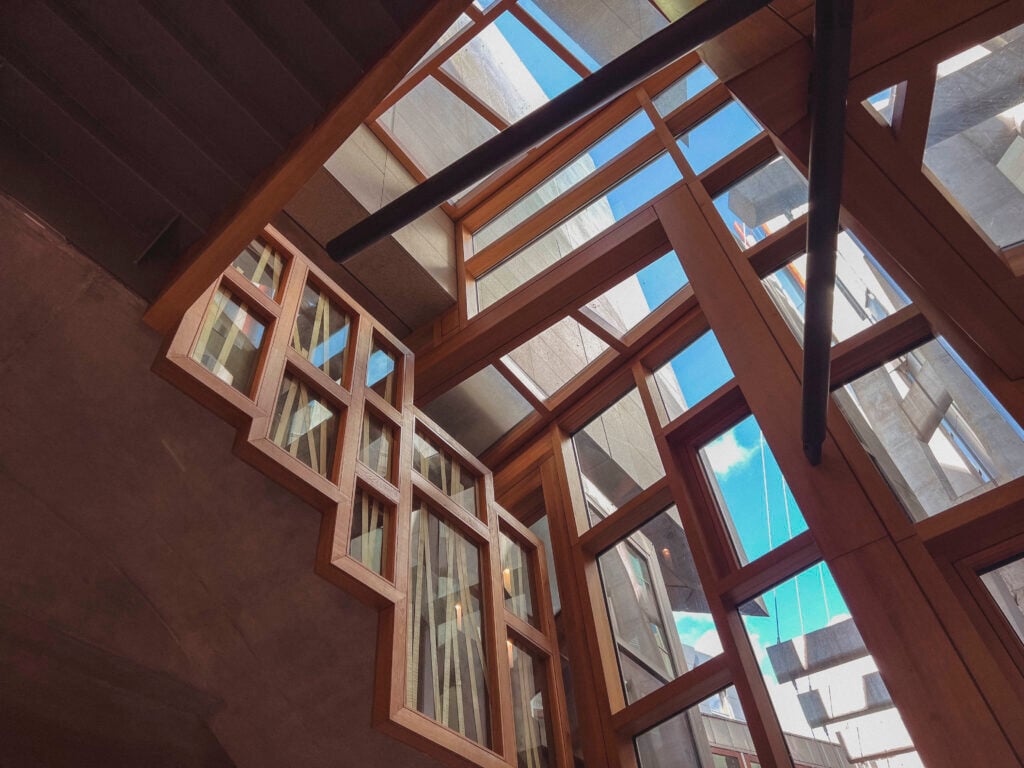
Once inside, there’s a small desk where someone can offer information about what to see. To be honest, the most impressive thing about a visit here is to look at the architecture as it’s all the more impressive inside.
Exhibition Space
You can visit the small exhibitions which showcase Scottish people of notability (for example, when I visited there was an exhibition detailing the life of the sprinter and rugby player, Eric Liddell). Around the corner in another room are photographs on display, taken by local artists.
Debating Hall
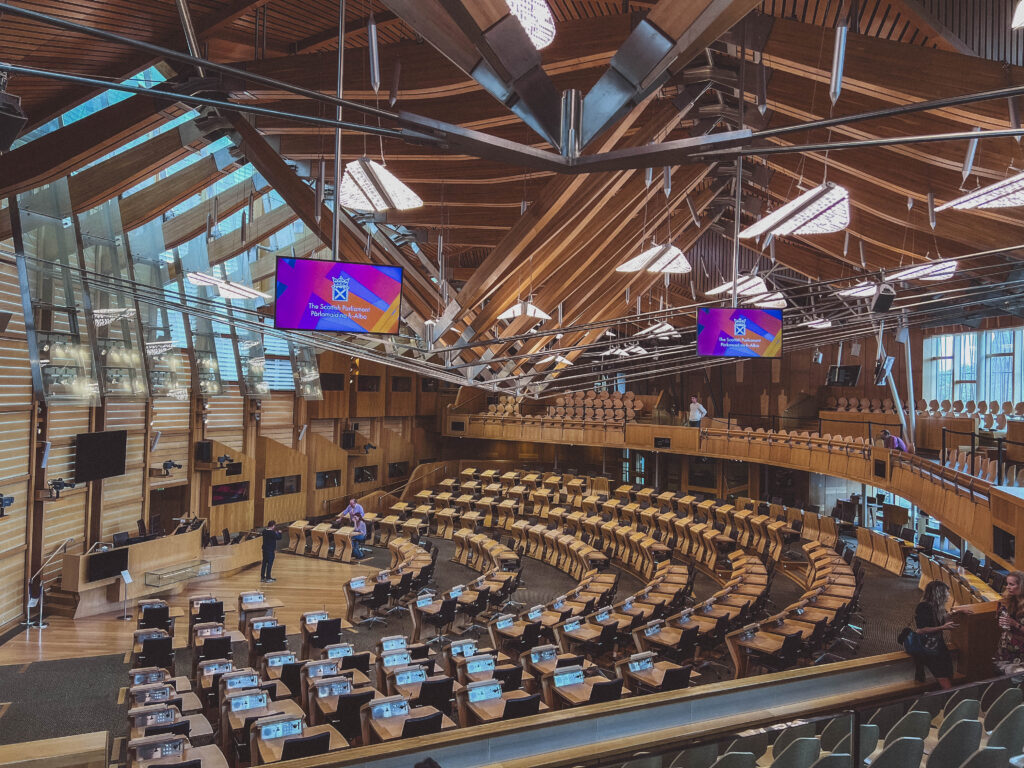
Found on the top floor via a set of staircases of the lift is by far the most impressive and important room of the building. The Debating Hall is a chamber of 131 seats arranged in a hemicycle, which is a design commonly used in European legislatures as it supposedly encourages consensus and compromise.
One of the most striking things about this room is the intricate structure and detailing of the ceiling, with various beams of wood and iron falling out from the ceiling, it’s hard to tell whats supporting what.
Gift Shop
Before reaching the gift shop as you exit, be sure to look up at the beautiful stone vaulted ceiling which makes up the corridor, and the carved feature that sits on the wall behind the reception desk.
The small gift shop sells all kinds of Scottish treats as well as postcards and prints of the architectural design of the building. Here, you can also find all kinds of books relating to Scottish politics and law.
Café
Found on the left as you enter the building is a small and quiet café which serves light lunches, snacks and refreshments.
Canongate Wall
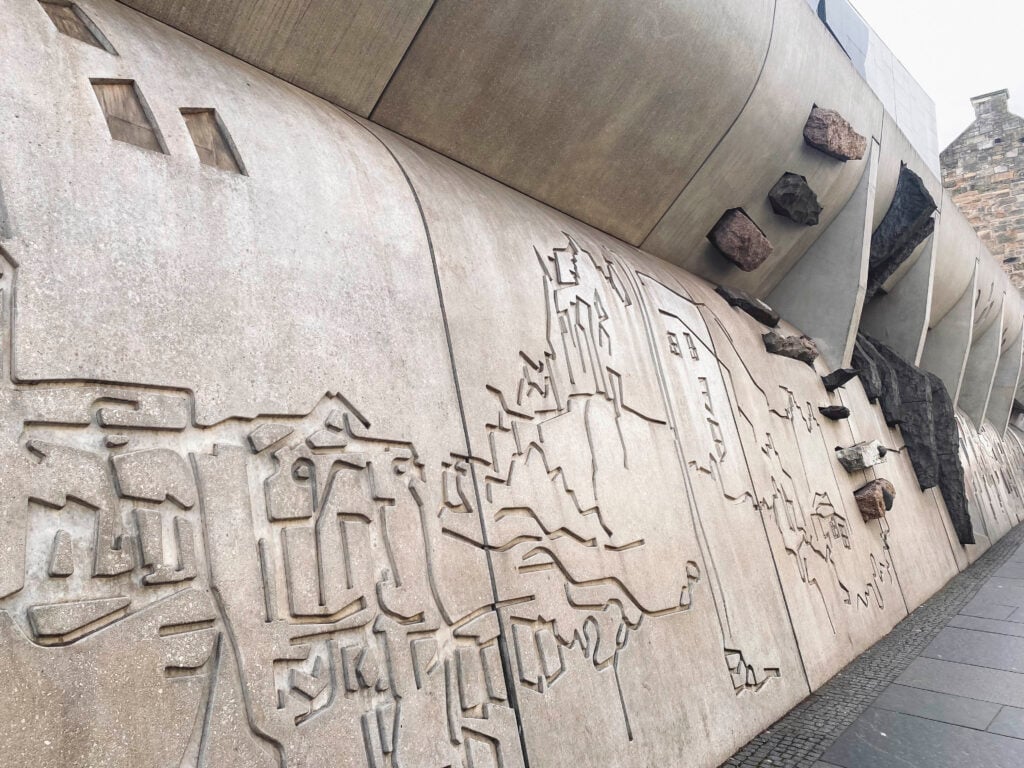
Set into the wall on the exterior of the Scottish Parliament building, facing the Royal Mile, is a section of igneous, metamorphic and sedimentary rocks from across Scotland which hold geological and historical significance, all of which were chosen by the people of Scotland.
What to see nearby
Holyrood Palace
The Palace of Holyrood or as it’s more commonly known, Holyrood Palace, is a grand 17th-century building and the official residence of the British monarch in Scotland. Located at the foot of the Royal Mile, opposite the Scottish Parliament, this historic sight is partially open to the public (for a fee) and visitors can uncover a treasure trove of paintings and artefacts linked with royalty throughout the ages.
The 15th-century ruins of an abbey sit at the back, and you can even visit the former chambers of Mary Queen of Scots, who lived in the palace between 1561 and 1567.
The King’s Gallery
Connected to the Holyrood Palace complex is an exhibit of art from the Royal Collection. The gallery was opened in 2002 by Queen Elizabeth II and is open to the public daily. Here, you can see a selection of historic portraits and landscapes within the Category B listed building.
You can either buy a combined ticket for Holyrood Palace and the King’s Gallery or choose to visit an individual one. A ticket admission allows entrance as many times as you wish for one year after purchase (however, it’s quite a pricey attraction to visit).
Arthur’s Seat
The Scottish Parliament is situated at the foot of this iconic hill, so it’s impossible to miss as it looms over it and the beginning of one of the trails to the top of Arthur’s Seat is minutes away.
Visible from miles around, at the heart of Scotland’s capital city lies the enchanting Àrd-na-Said, better known as Arthur’s Seat. This extinct volcano erupted over 340 million years ago, and a climb to its summit and taking in the breathtaking views of Edinburgh’s landscape is one of the city’s best walks. Read our guide on how to climb Arthur’s Seat here.

Dyanamic Earth
Located just behind the Scottish Parliament is the huge white tent-like bubble, Dynamic Earth. This science centre and planetarium takes visitors through a scientific history from the Big Bang to the present day. Although catered more towards children, this makes for a fun way to spend a rainy afternoon in Edinburgh.
The Royal Mile
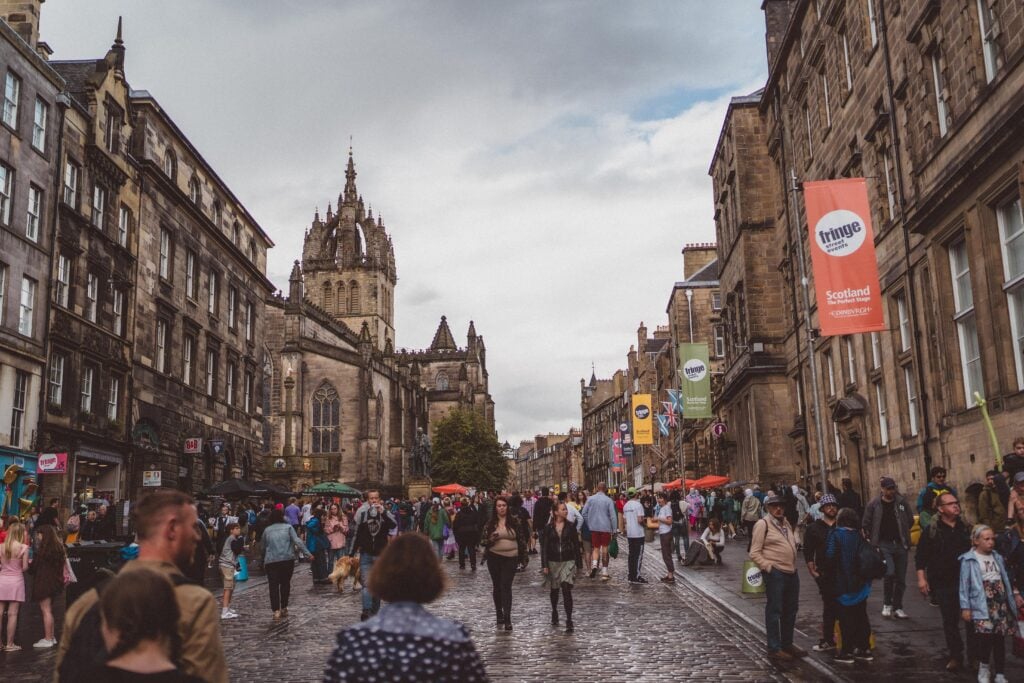
Edinburgh’s most famous road, the Royal Mile, connects Holyrood Palace to Edinburgh Castle and stretches the distance of approximately one Scots mile (slightly longer than a standard mile and obsolete by the 19th century).
This street used to be the traditional processional route of monarchs and is a long stretch of cobblestones, peppered with offshoots of small narrow alleyways and closes that hide a world of curiosities. Simply wandering the little lanes and seeing what treasures lie in wait is the best way to explore!
The Royal Mile is the second busiest street in Edinburgh, after Princes St, and strolling along it you’ll find the city’s biggest cathedral, St. Giles, several museums, pubs and lots of souvenir shops.


Enjoyed reading about how to visit the Scottish Parliament? Pin this article now, and read it again later:

> Edinburgh insider’s guide
Ultimate Guide to Edinburgh, Scotland
$19.95
Want more handy information to bring with you on-the-go? This is the ultimate travel guidebook filled with insider knowledge (from a local), the best go-to spots, practical tips and stress-saving hacks that will make your trip truly unforgettable!


