Wallace Fountains: An Unexpected Iconic Feature of Paris
Last Updated on 16th October 2023 by Sophie Nadeau
This post may contain affiliate links. Please check out my privacy policy and disclosure for more information.
The Wallace Fountains of Paris are as essential to the landscape of Parisian architecture as the Arc de Triomphe but are often not thought of as such. Here’s a history of the fountains, as well as how to see them for yourself.
After you’ve seen the Haussmannian buildings and the Eiffel Tower, there are plenty of other more under-the-radar symbols of Paris that many people see on a daily basis but fail to think of when asked to think of iconic markers of the French capital. I personally love trying to spy the Wallace Fountains when wandering around the city as there are some pretty unusual and colourful ones to be found!

Contents
What are the Wallace Fountains?
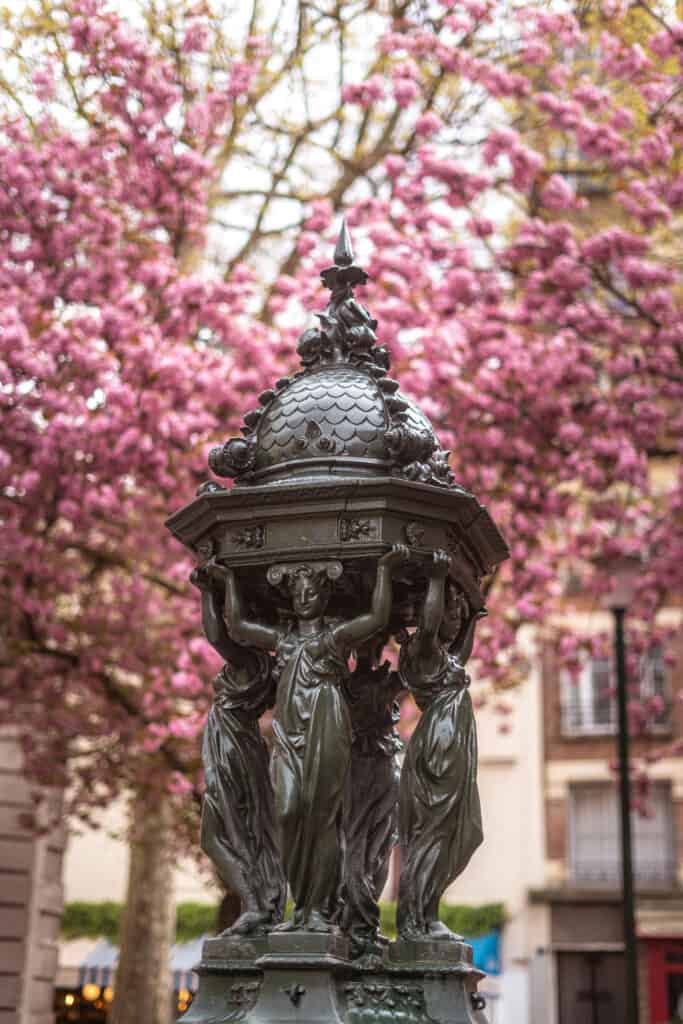
If you’ve clicked on this article to discover exactly what the Wallace Fountains are, then you’ve come to the right place. Dotted across the city and designed in the 19th-century, the fountains are characterised by their green cylindrical sculpted appearance.
Unlike many other water fountains across the city, these fountains are designed as drinking fountains and have distributed free and clean drinking water to the people of Paris for around 150 years.
As you might have guessed from their name, the fountains are named for Englishman Richard Wallace. There are four designs for the fountains, two of which features the four caryatids, the other being a lower water pump style of design.
A history of the Wallace Fountains
The history of the Wallace Fountains in Paris dates back to the 1870s. Following the Franco-Prussian war, the city of Paris was badly damaged. Parts of the city, such as the Palais-Garnier Opera house, Boulevard Raspail were swiftly transformed and rebuilt over the course of a decade.
During thisntome, the idea of ‘philanthropy’ became ‘fashionable’ amongst the bourgeoisie of French society. One such person who was known for being particularly generous was Sir Richard Wallace, an art collector and Englishman living in Paris.
In August of 1870, Wallace inherited a fairly substantial sum in inheritance from his father, which he decided to pay forward to the people of Paris. As well as creating the Wallace Fountains, Wallace also constructed a hospital in Paris and is now buried in Père Lachaise Cemetery.
As a direct result of the Franco-Prussian war, many of the aqueducts delivering water into the city were destroyed. The price of water soared to an all time and access was incredibly limited to those who most needed it.
The very first fountain was unveiled to the public in August 1872 and was an immediate success. The location of the fountains was of the utmost importance and this was delegated to Eugene Belgrand, who was Director of Water and Sewers of Paris.
Unique features of the Wallace Water Features
As mentioned, there are four different designs for the fountains. When it came to designing the fountains, Charles-Auguste Lebourg, a sculptor hailing from Nantes, was appointed as the man for the job.
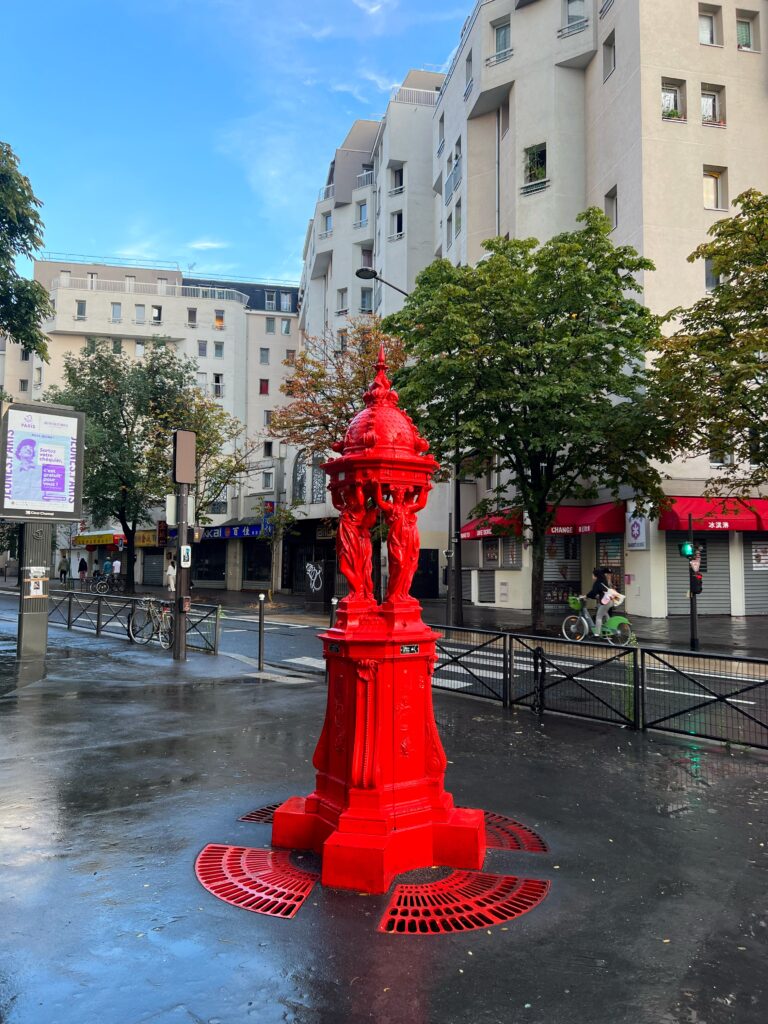
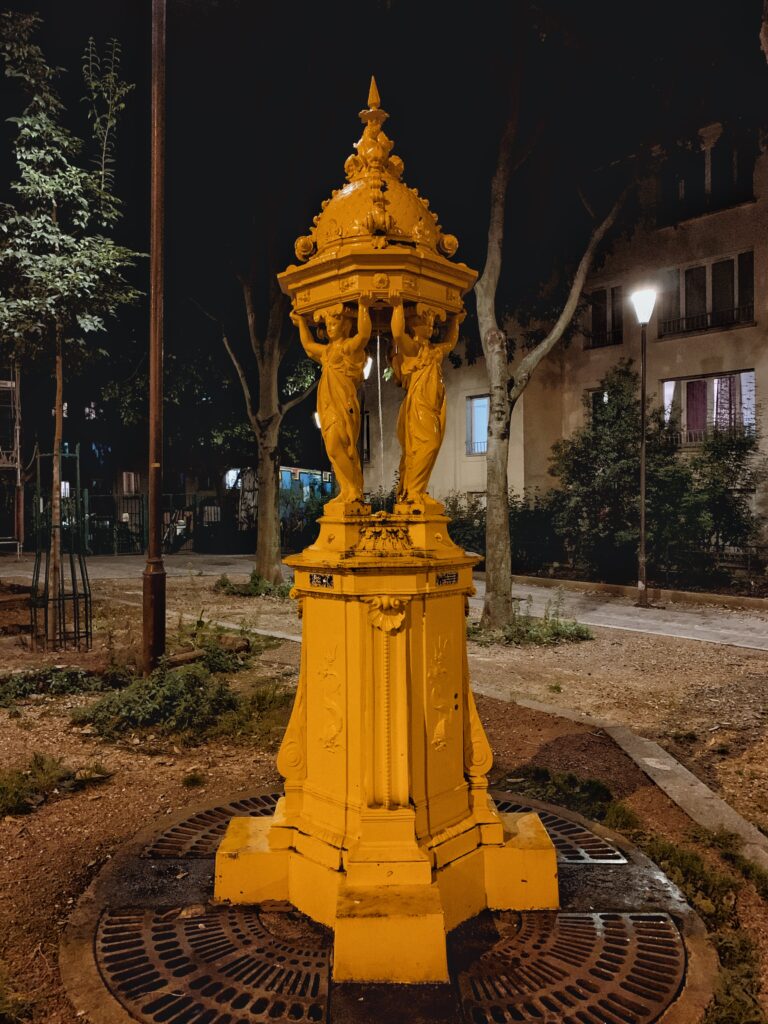
The colour green was chosen as it was determined that this would be the shade that would most blend into the Parisian landscape. Though the majority of Wallace Fountains still in existence remain a dark green colour, there are a few notable exceptions, including yellow, blue, and pink fountains.
Cast iron was chosen as the material for the fountains as this was relatively cheap to produce and was widely available. The fountains had to be high enough to be able to be easily spotted but not so high that they ‘ruined the harmony of the Parisian landscape’.
After all, even in time of desperate need, the bourgeoisie still considered Paris a place that needed to be ‘kept beautiful’. The form was meant to be both practical and aesthetically pleasing.
In total; there are four forms of the fountain, a large form, a wall mounted model, a small model, and the colonnade model (which is just a smaller version of the larger model with columns instead of caryatids).
How to visit the Wallace Fountains
Though some water fountains are located in parks which have open and closing hours, other fountains can be found along the side of the street. One such example that springs to mind is that of the fountain next to the Saint-Paul Métro station in Le Marais.
Today some Wallace Fountains even have soap dispensers installed so that you can easily wash your hands when out and about in the city.
If you’re particularly interested in learning more about Eau de Paris, then I really enjoyed the Zac Efron documentary on Netflix (the Eau de Paris features on one of the ‘Down to Earth’ episodes). Otherwise, you should know that, today, there are 103 Wallace Fountains in Paris.
So popular are the Wallace fountains, that they can now be found in several other cities and towns across l’Hexagone. These towns include Bordeaux, Nantes, Agen, Toulon, and Besanćon among other places.