
Chartres Cathedral: History, Stained Glass & Visiting Guide
Last Updated on 16th October 2026 by Sophie Nadeau
This post may contain affiliate links. Please check out my privacy policy for more information.
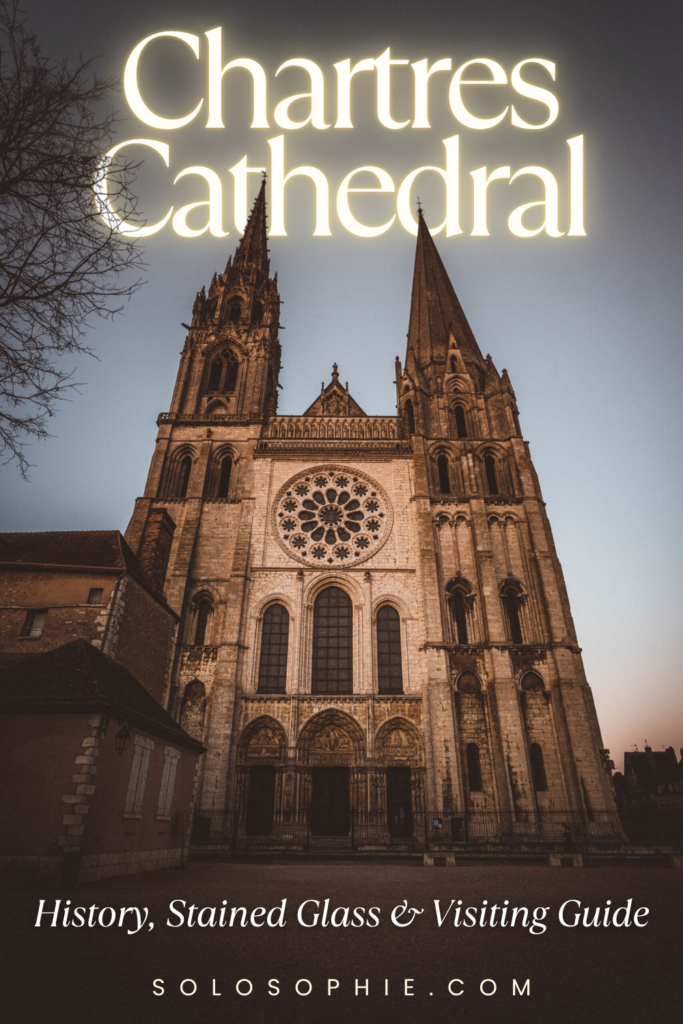
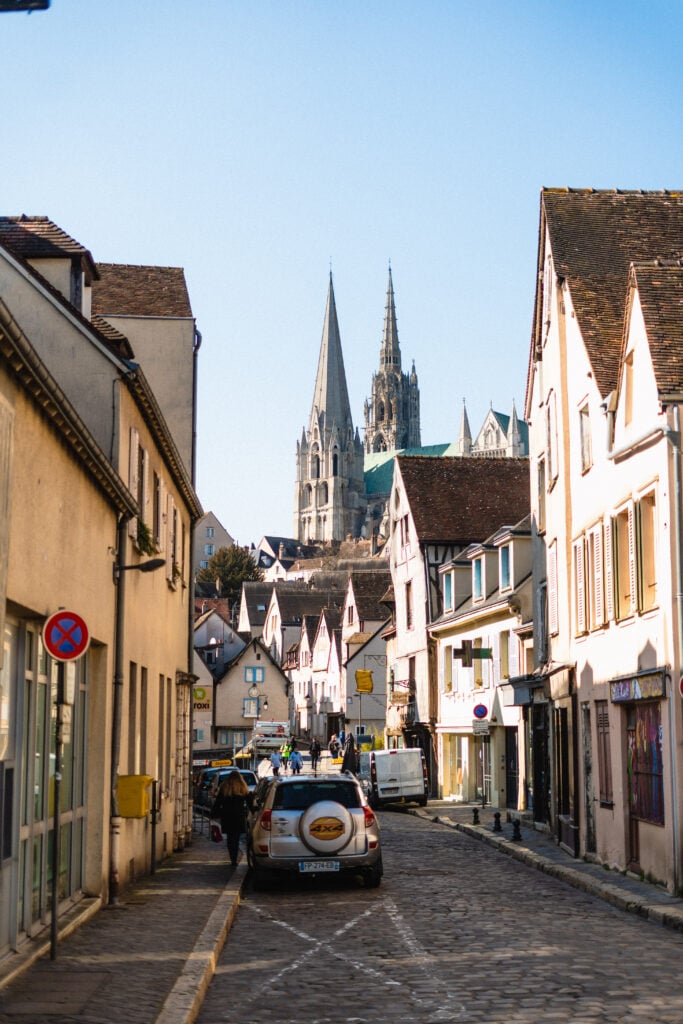
This towering cathedral, adorned with over 170 remarkable stained-glass windows and stonework that would take hours to see all of it, stands tall in a small French town, just an hour outside of Paris. Chartres Cathedral is often referred to as one of the most magnificent Gothic cathedrals ever built. Since the 12th century, the cathedral has been an important site for travellers, a fact that is soon apparent once you know its history. Here’s your ultimate guide to Chartres Cathedral and how to visit!
Is Chartres Cathedral Worth Visiting?
Absolutely! Chartres Cathedral actually boasts the world’s largest surviving collection of medieval stained glass, filled with stories, symbolism, and history that can be traced back to around 1145. Aside from this impressive fact, the stunning Gothic architecture and intricate details of its stonework alone make it well worth visiting.
For such a small town of just short of 40,000 people, it holds one of the best-preserved and most influential masterpieces of High Gothic architecture in the world. And so, even if you don’t think of yourself as an avid lover of architecture, it’s likely that Chartres Cathedral will change your mind. Better yet, the cathedral also has an annual light show which lights up its facade most of the year, every day after dusk; this in itself is a perfectly good reason to make a trip to Chartres. A visit to Chartres and Chartres Cathedral is one of the best day trips from Paris.
Good to Know
There’s a law in France that means all places of worship have to be free to enter, including cathedrals. This means that the main body of every church is free to visit, including Chartres Cathedral.
A Brief History of Chartres Cathedral
The early history of the cathedral
Chartres Cathedral, or Cathédrale Notre-Dame de Chartres, as it’s known in French, is a Catholic church dedicated in honour of the Virgin Mary (‘Our Lady’), and it is the seat of the Bishop of Chartres. There have been at least five churches on this site before the cathedral you see today, with the earliest dating back to the 4th century.
Chartres as a medieval pilgrimage destination
Long before Christianity, the site on which the cathedral stands has been considered sacred, even by the Druids. However, it’s the relic known as the Veil of the Virgin that has made Chartres such an important pilgrimage destination.
The Sancta Camisa (the Veil or Tunic of the Virgin Mary) is a piece of cloth that the Virgin Mary is said to have worn when she gave birth to Jesus. This silk cloth was actually donated to the cathedral in 876 AD by King Charles the Bald (it even survived the fire and the French Revolution) and is displayed in the north choir ambulatory in a golden frame.
It’s been recorded that more than 80,000 individual pilgrims come to the cathedral each year to bring their intentions to the Virgin Mary.
The fire of 1194 and the rebuilding
While it’s hard to believe now, as Chartres Cathedral is so often referred to as a Gothic masterpiece, the cathedral actually started as a Romanesque church. Traces of its Romanesque past can still be seen on its western facade, but sadly, most of its original features were destroyed after a devastating fire.
Although fires have been recorded at the site before, the destruction caused on the night of June 10th, 1194, completely engulfed Chartres Cathedral. Only the crypt, the towers, the new façade, and the sacred relic survived. This is why a lot of the building you see today was constructed between 1194 and 1220. Like many cathedrals in France, the Cathedral of Chartres took several centuries to complete, and the resulting edifice is not symmetrical in appearance.
Chartres Cathedral today
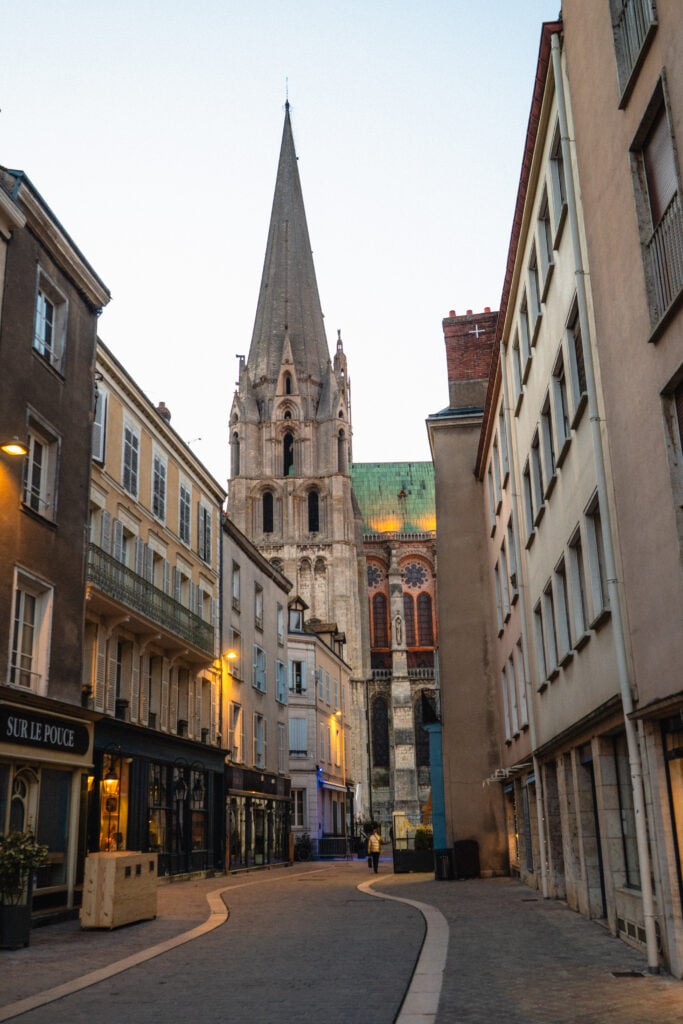
Today, Chartres Cathedral stands proudly at the very heart of the town. The UNESCO-listed cathedral of Our Lady of Chartres draws in nearly 2 million visitors per year and is undoubtedly the main attraction in the small French town. As per French law regarding entering religious buildings, it’s completely free to visit during opening hours.
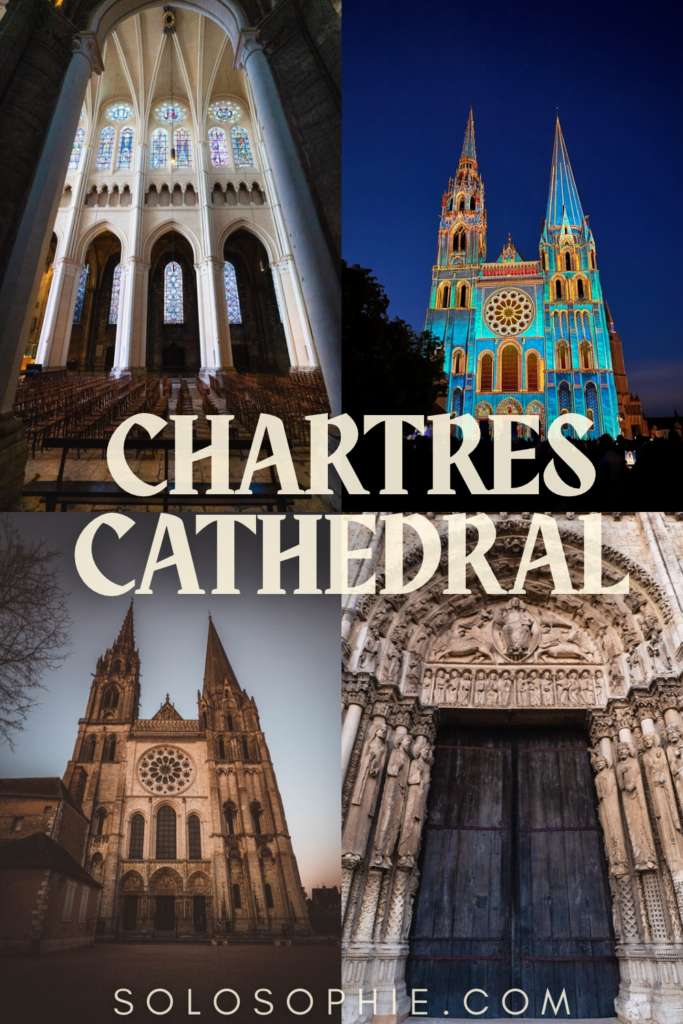
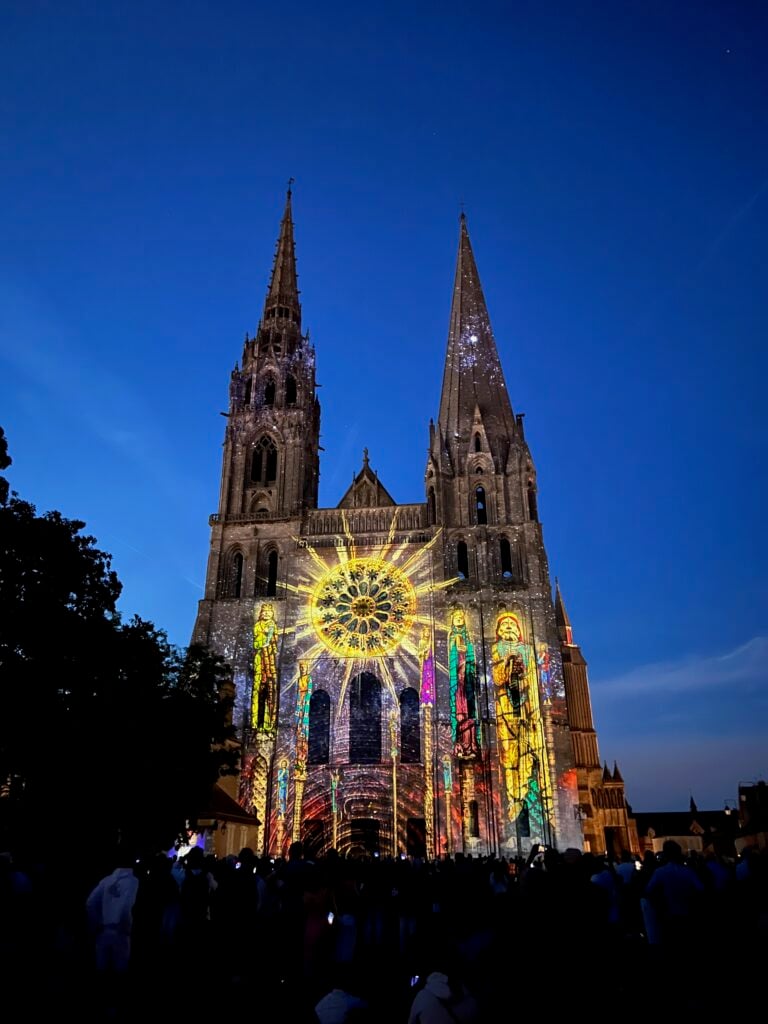
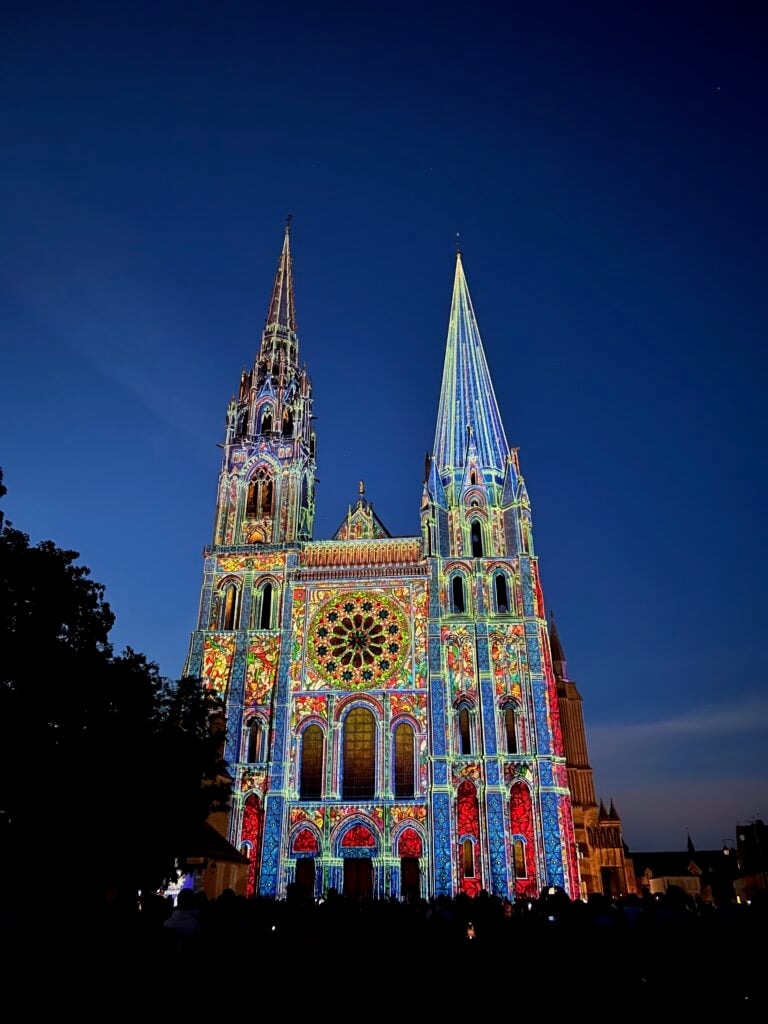
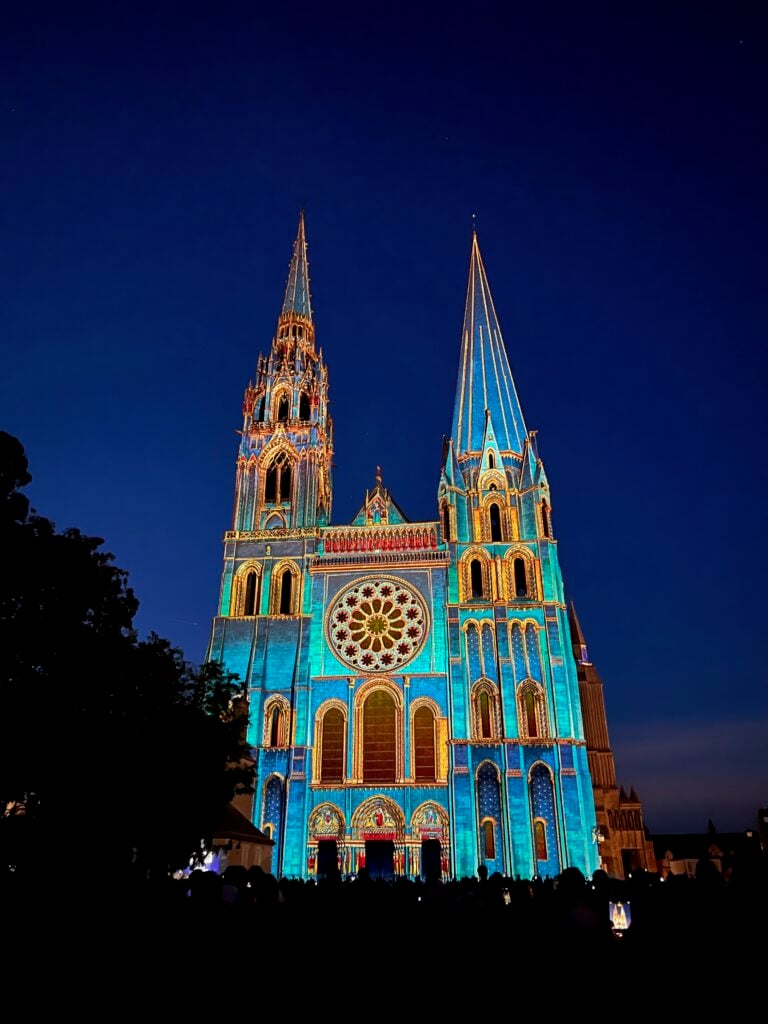
For nearly two decades now, the cathedral has been lit up by lights, showcasing its extraordinary architecture and beauty to those who visit Chartres. While the light show has evolved, it’s now become a permanent event. Chartres en lumières (Chartres in lights) is the world’s largest free heritage illumination event, which is held nightly from April to January, starting at dusk each evening. Sound and light are projected across the cathedral, bringing it to life in the night sky. It’s well worth the trip to see, even if you choose to do it as a day trip from Paris!
Things to See at Chartres Cathedral
The Royal Portal and western façade
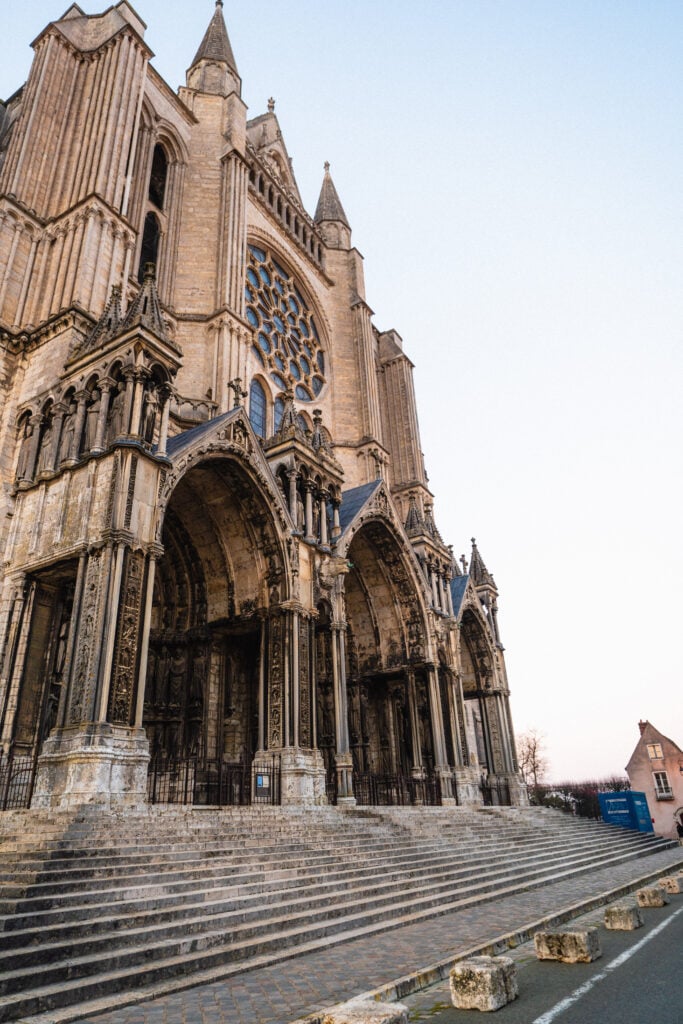
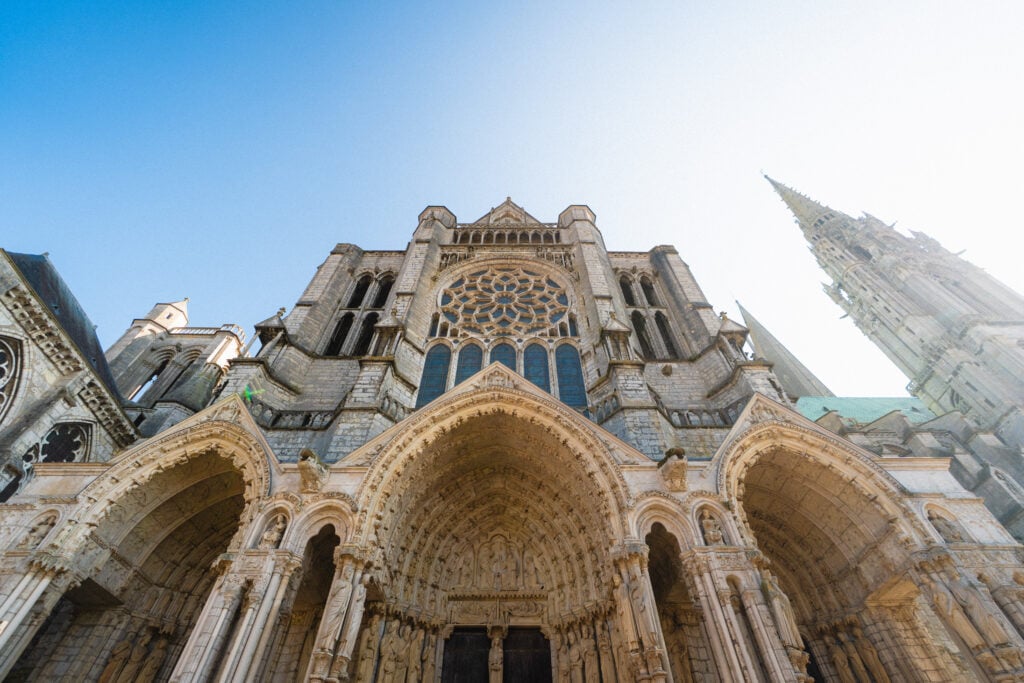
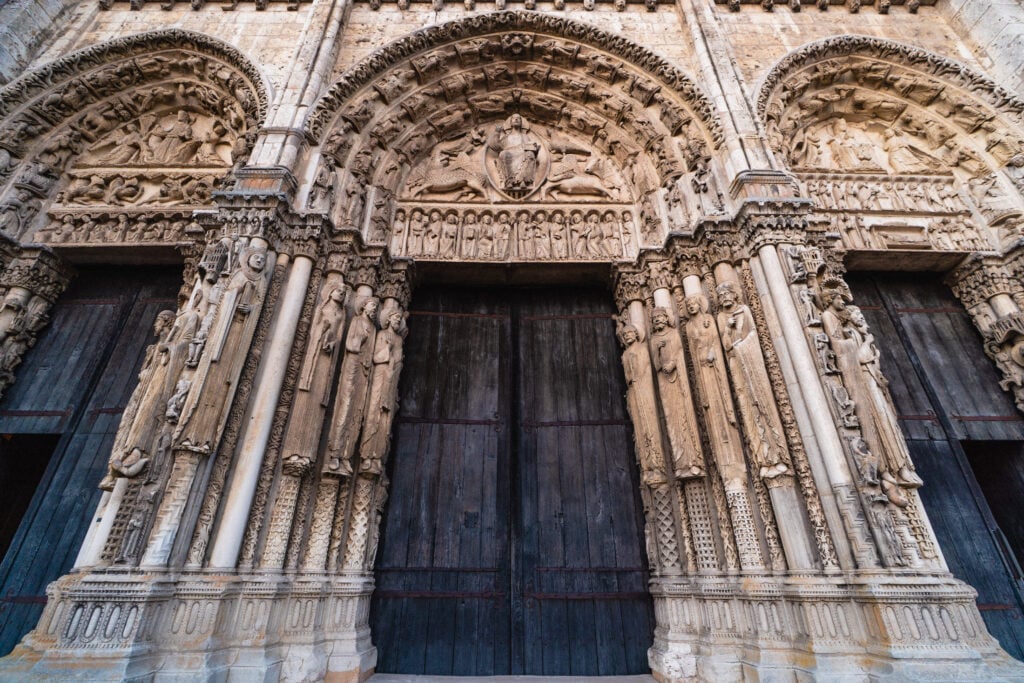
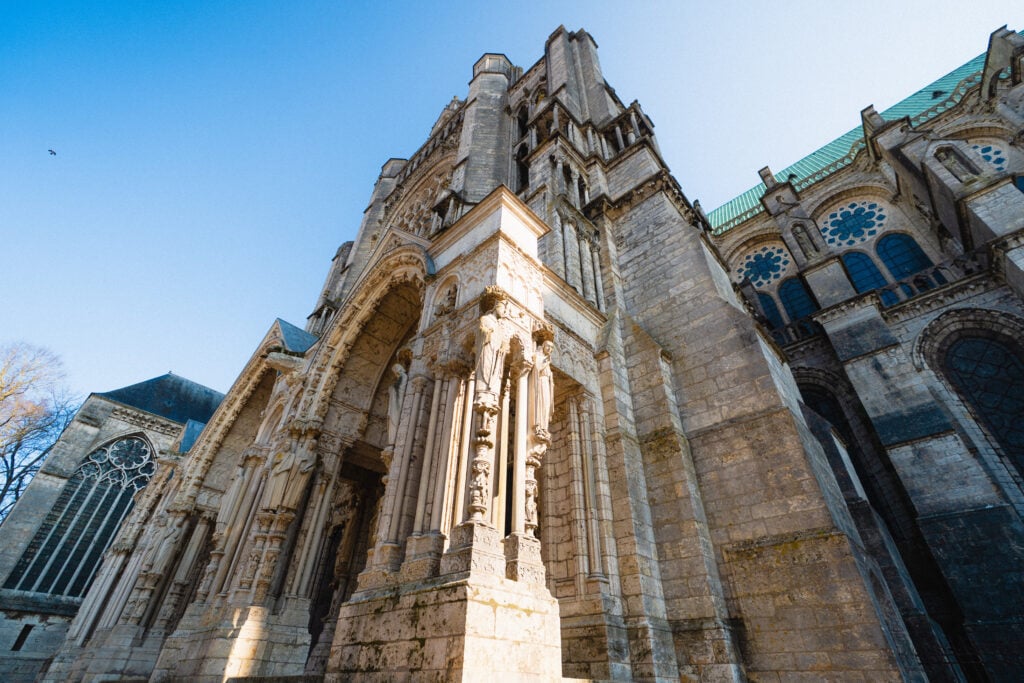
One of the few surviving parts of the earlier Romanesque church post-fire is that of the magnificent triple-entrance western façade of the cathedral. Built between 1145 and 1155, the Royal Portal (Portail Royal) is perhaps one of the most stunning cathedral entrances I’ve ever had the pleasure of wandering through.
Each of the three doorways highlights a different chapter of divine history and Christ’s role; essentially, the entrance is one huge picture book. But what makes the carvings of these doorways so significant is that they’re literal 3D figures intricately carved with outstanding details for their time. Indeed, you could spend hours alone looking at the doorways to Chartres Cathedral, marvelling at this rare 800-year-old art. Furthermore, the cathedral’s western façade offers a fascinating glimpse into the transition from Romanesque to Gothic architecture.
Tympanum
One of the most fascinating features of Chartres Cathedral’s Royal Portal is its intricately carved tympana. These semi-circular stone panels sit above each of the three doorways, depicting scenes from the life of Christ and showing a little window into the religious beliefs and storytelling traditions of the medieval period.
Cathedral floor & labyrinth
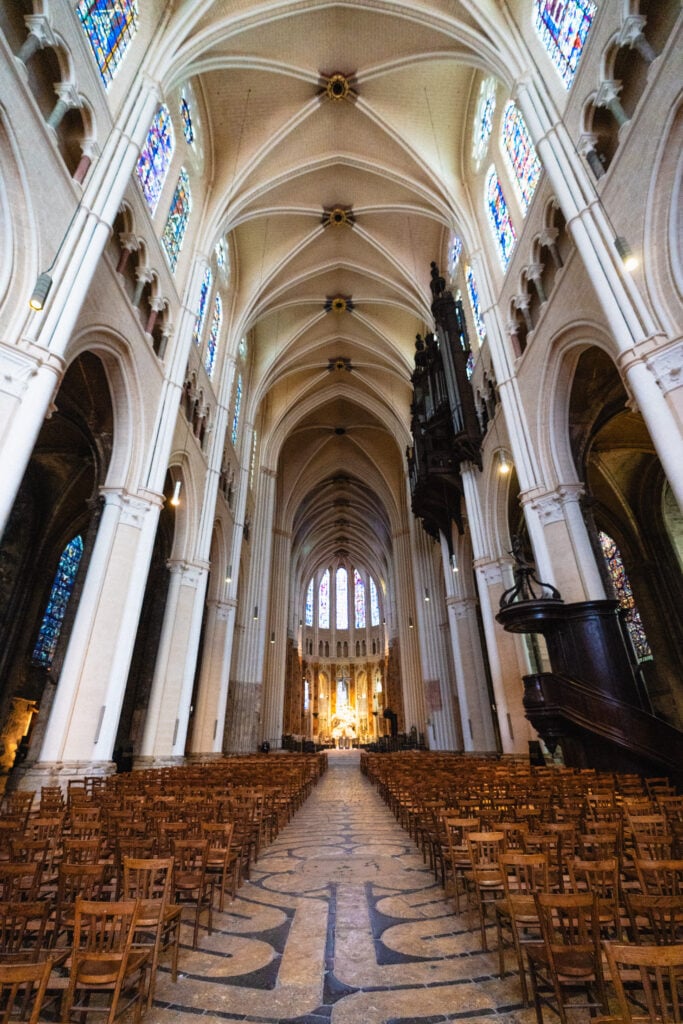
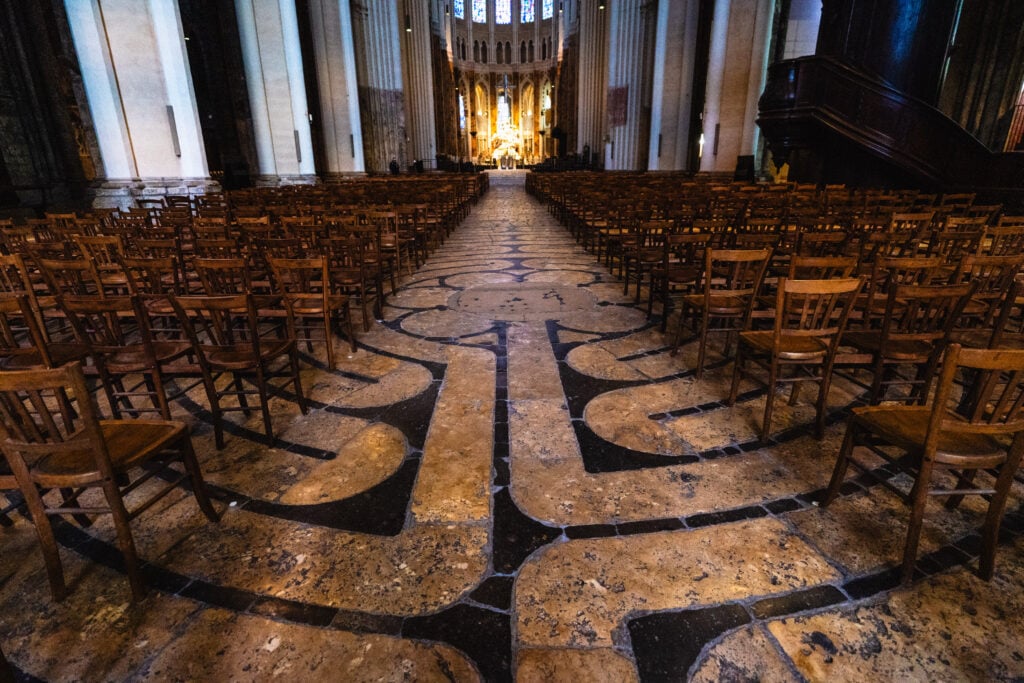
One of the cathedral’s most unique features (among the many it holds) is the labyrinth floor. It’s actually one of the only original medieval labyrinths in a French cathedral nave that has survived completely intact. Many were ordered to be destroyed by church officials during the 18th and 19th centuries because they felt that tourists, children, and practitioners walking them distracted from regular religious services.
This particular labyrinth was built around 1201 to serve as a path for spiritual pilgrimage. You can only walk the labyrinth at certain times of the year; otherwise, there is usually seating covering it. The labyrinth is only open on Fridays during Lent, through to All Saints’ Day.
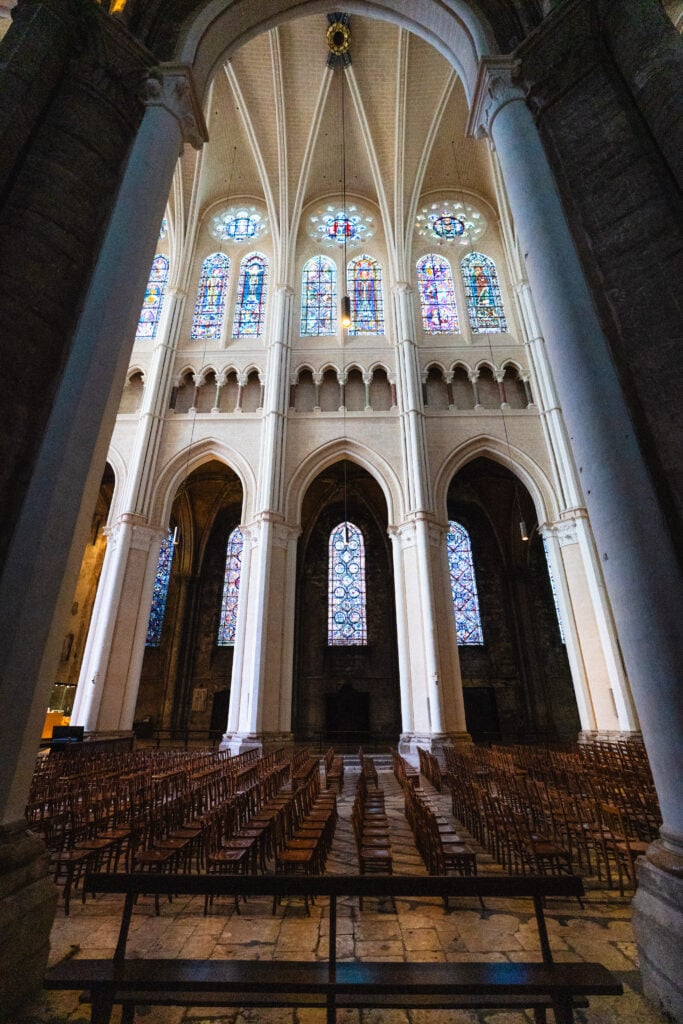
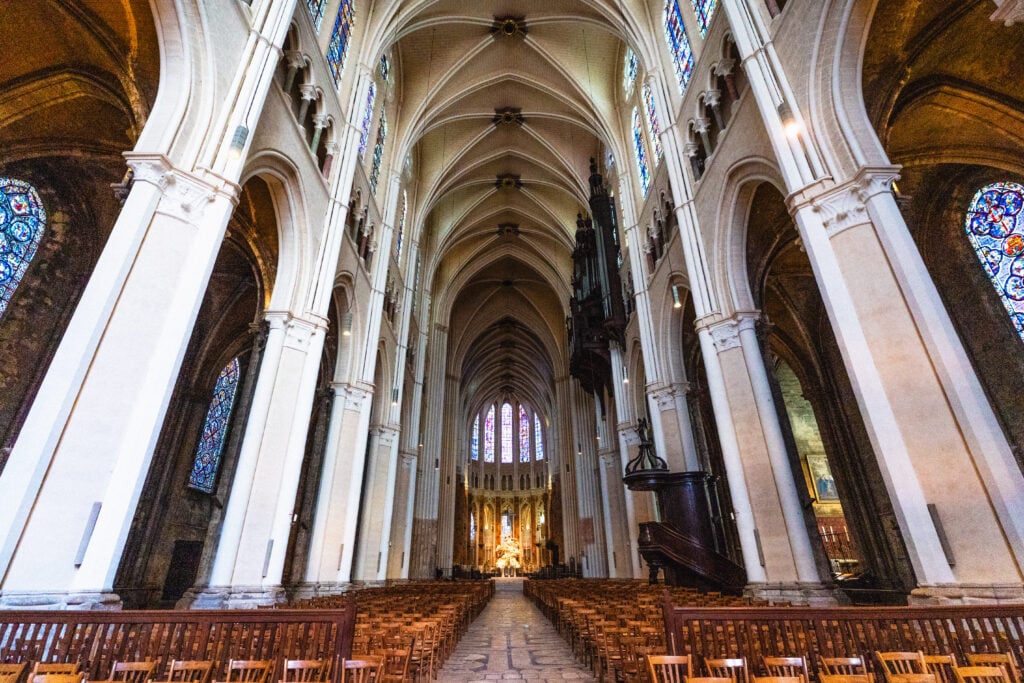
As soon as you step inside Chartres Cathedral, its soaring vaulted ceilings, pointed arches, and seemingly endless towering columns really make your head tilt the full 90 degrees. The height and amount of light (thanks to the hundreds of stained-glass windows) and the roomy sense of the space perfectly define the Gothic style.
The choir and its sculpted enclosure
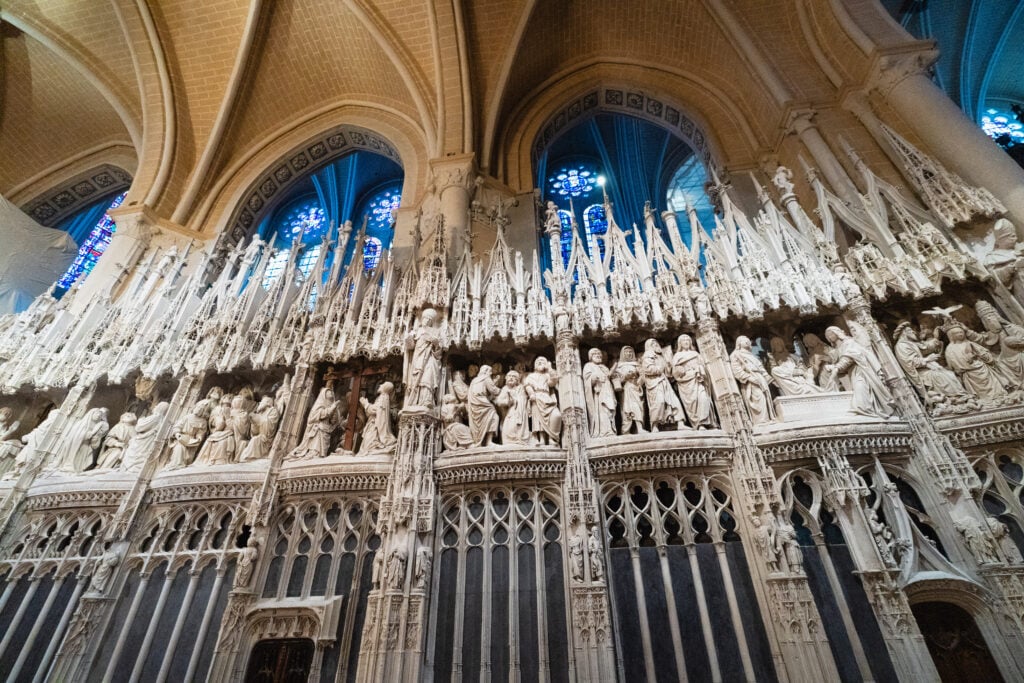
Another intricately stone-carved storybook can be found just behind the nave in the form of the monumental choir enclosure, known in French as the Tour du Chœur. Stretching some 100 metres and standing approximately six metres tall, this sculpted stone screen separates the liturgical choir from the surrounding ambulatory and pilgrims’ aisles. The highly detailed sculptures depict scenes from the lives of Christ and the Virgin Mary.
24-hour clock on the cathedral exterior
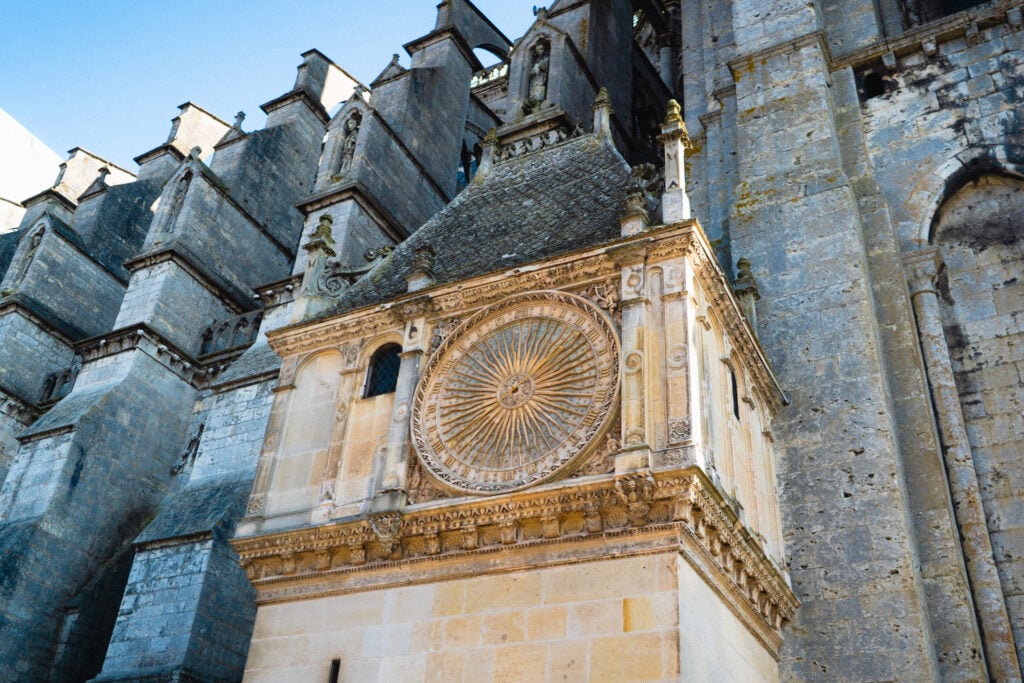
One of my favourite features of Chartres Cathedral has to be that of its timepiece, which resides on the cathedral’s north side. This is actually one of two clocks inside the cathedral; it also houses an astronomical clock, which was installed in the choir tower some time in the 16th century.
The intricate clock on the cathedral’s exterior was built in the 16th century (around 1520, to be exact). The clock is a carved stone medallion that features a 1-meter-wide dial that marks each half-hour with rays of light and is divided into 24 hours. This hidden gem of the cathedral is one of the most beautiful clocks in France!
The Blue Virgin window
You may well have heard of the term ‘Chartres Blue’, used to describe the deep cobalt shade of blue, which, of course, comes from the stained glass of Chartres Cathedral. The Blue Virgin Window (also known as Notre-Dame de la Belle Verrière) is located in the south ambulatory, and it depicts a scene of the Virgin Mary wearing a rich blue robe and crown, sitting on the throne of wisdom with baby Jesus, as he raises his hand in blessing.
The north and south rose windows
More examples of Chartres Cathedral’s stunning stained glass windows can be found in the north and south sides of the building. The north and south rose windows are masterpieces of 13th-century Gothic stained glass, both of which measure around 10 meters wide. The north window is dedicated to the Virgin Mary and surrounded by Old Testament kings and prophets, alongside symbols of the French royal family.
In contrast, the south rose window depicts the Apocalypse and the Second Coming of Christ, with Christ enthroned at its centre, surrounded by angels, the four Evangelists and the 24 Elders.
The crypt and underground history
Beneath Chartres Cathedral lies the largest crypt in all of France, and it predates much of the Gothic cathedral seen today. The main crypt was commissioned by Bishop Fulbert between 1020 and 1024, and it extends more than 200 meters beneath the cathedral.
It’s still actually possible to venture down and visit the crypt on a guided tour, but this isn’t the same as the cathedral’s guided tours. The crypt can only be visited, instead, on a guided pilgrim’s tour, which typically takes place daily at 2 pm. No advance booking is required, although it’s worth checking the official cathedral website for the latest schedule before visiting.
The cathedral towers and views over Chartres
You can only climb the North Tower, which is also known as the clocher neuf (the new bell tower). But you can only visit the top of the tower on a guided tour. This striking Flamboyant Gothic architecture, you’ll soon see, pierces much higher into the sky than its fellow Romanesque spire sat adjacent. The tower stands around 112 meters high and is intricately carved from local Berchères stone.
Chartres en lumières
As mentioned, this is the world’s largest free heritage illumination event, so you can’t really visit Chartres without seeing it. The light festival, which has turned into an annual tradition, happens every night at dusk between April and January (so I recommend visiting during these months, which is luckily most of the year!)
Completely free to enjoy, the sound and light projections transform Chartres Cathedral after dark, bathing its façade in colourful neon lights and bringing its history to life through dancing images and vivid visual displays. To be honest, even if it’s just one night in Chartres (which is about the time I would recommend anyway), I stand by it when I say that seeing this light show is a once-in-a-lifetime experience and an absolute must-see.
What’s so special about Chartres’ medieval windows?
Considered one of the greatest Gothic treasures of France, the cathedral features tall flying buttresses, allowing architects to create larger windows. Indeed, Chartres Cathedral holds nearly 2,600 square meters of original medieval stained glass (around 170 or so windows), making it the largest and best-preserved 12th- and 13th-century glass collection in the world.
How Long Does It Take to Visit Chartres Cathedral?
To be honest, we spent just under an hour looking around the cathedral before coming back in the evening to watch the light show. The guided tours themselves, which are available through the cathedral’s official website, generally take around 1 hour to 1 hour 20 minutes (this includes climbing the North Tower, which is available only on guided tours).
How to Visit Chartres Cathedral
Chartres Cathedral is open to the public every day from 8:30 AM to 7:30 PM (with last access at 7:15 PM). During the summer months, it can sometimes be open as late as 10 PM. You can still visit on Sundays during Mass, but to be honest, I wouldn’t recommend this unless you are attending yourself, just as a matter of respect.
When visiting, be sure to wear appropriate attire; this typically means clothing that covers your shoulders and knees. Though I have noticed that in France they can be quite relaxed about this, it’s always best to be respectful of local customs.
If you wish to walk the Medieval labyrinth, you can do so on Fridays from 10:30 AM to 4:45 PM from the start of Lent (usually late February/March) through to November 1st (All Saints’ Day).
If you want to book a guided tour, you should do so online before your visit. From looking online, the schedule is quite inconsistent, as the tours tend to work around what’s happening at the cathedral at the time. The tours are done in French only, but there are audioguides in several other languages which you can use. The tour usually costs just over €5.
Looking further afield
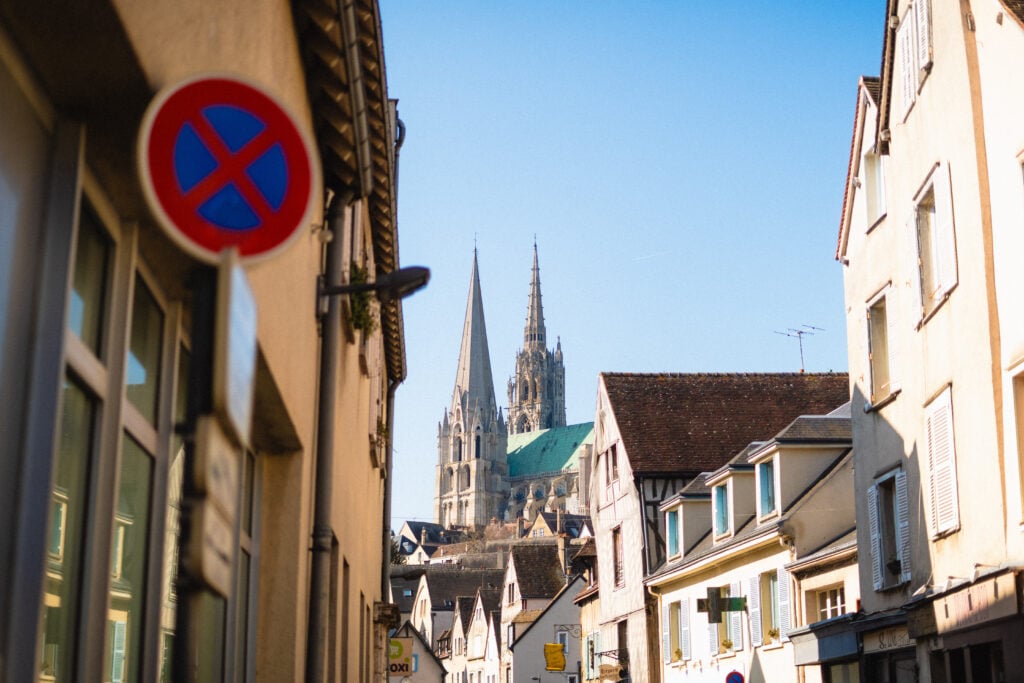
Chartres is a lovely city centred around its magnificent cathedral, but beyond its ecclesial sight you’ll find plenty more to explore. Best visited over the course of a day, or a leisurely weekend if you prefer, Chartres is the perfect place for discovering the town’s little gardens, gorgeous architecture, and tasty local cuisine.
Enjoyed reading our guide to Chartres Cathedral and how to visit? Pin this article now, and read it again later: