How to Visit Kiyomizu-dera, a Cherished Treasure of Kyoto
Last Updated on 27th June 2024 by Sophie Nadeau
This post may contain affiliate links. Please check out my privacy policy and disclosure for more information.
Home to the holy place of Kannon, the god of mercy, Kiyomizu-dera (清水寺) is a place of wonder and considered to be one of the most well-known temples in Japan. Famed for its floating stage with an intriguing past and boasting of captivating views overlooking Kyoto.
From shrines of love, to risking death for a leap of faith, and pagoda’s said to bring about safe childbirth. Here’s your ultimate guide on how to visit Kiyomizu-dera, as well as a brief history and how to get there.
What is Kiyomizu-dera?
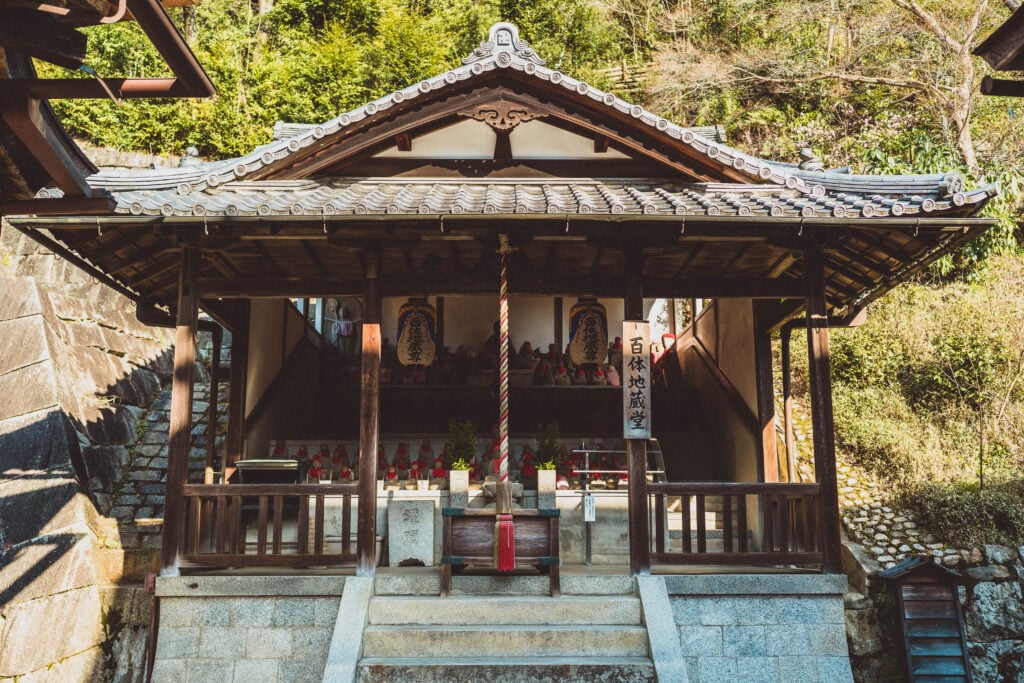
The temple takes its name from the pure water which runs off of the nearby hills, with Kiyomizu translating to ‘clear water’, or ‘pure water’. Kiyomizu Temple, 清水寺, means ‘Pure Water Monastery’ is a historically significant Buddhist temple in eastern Kyoto and was built to foster the worship of the Buddhist god Kannon (God of Mercy).
Considered to be one of the most well-known temples in all of Japan, the temple is part of the Historic Monuments of Ancient Kyoto, alongside Kinkaku-ji, Nijō Castle and several other temples and shrines.
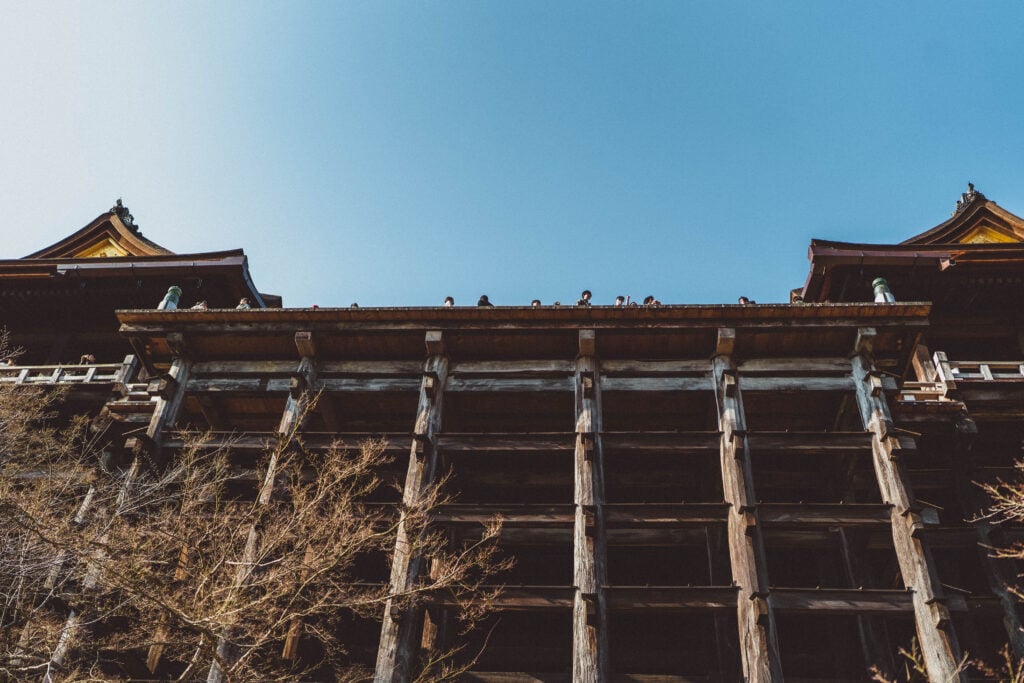
Elaborately built in the elegant shinden-zukuri style, Kiyomizu-dera is perched on the cliffside and is supported by 168 wooden pillars.
The temple complex spreads over an impressive 130,000 square meters. Compromising of a main hall with a large veranda, with the Otowa waterfall beneath, where three channels of water fall into a pond.
There is not a single nail used in the entire structure, instead relying on locking wooden joints, which is pretty typical of traditional Japanese carpentry. There are also several other small shrines scattered around the complex.
Where is Kiyomizu-dera?
Kiyomizu-dera is located on the wooded foothills of Mount Otowa, on the site of the Otowa Waterfall. It is part of the Higashiyama mountain range which dominates eastern Kyoto, situated within the Gion district.
A history of Kiyomizu-dera
Once upon a time a priest from Nara received a vision from an old man in white, telling him to construct a temple next to pure water, that being the Otowa spring.
Inspired by his vision, Enchin Shonin went to the east of Kyoto on the slopes of Mount Otowa in search of a site to build, in the late Nara period in 778. While wandering nearby to the waterfall, Enchin is said to have met a Buddhist recluse called Gyoei Koji, who gave him a piece of wood from a sacred tree.
Enchin went on to carve the sacred wood, creating an image of the eleven headed and thousand armed god of mercy, Kannon. After building a small hut in which to shelter this holy symbol, it was then that the first foundations for the Kiyomizu-dera temple were laid out.
In 798 the temple grounds were improved and built upon by the shogun, Sakanoue Tamuramaro, building the main large temple hall.
Much later, in 1629, as so often with many of Japan’s ancient wooden buildings, much of the temple grounds burned down and were destroyed by fire. Much of the temple’s buildings seen today were constructed in 1633, ordered to be built by shogun Tokugawa Iemitsu.
Although the first fire was the most severe, it would not be the last. Since then parts of Kiyomizu-dera have burnt down and been rebuilt almost ten times!
Over the course of centuries, Kiyomizu-dera has evolved into one of the most significant and influential temples in Japan and today, it is one of the most celebrated in Kyoto. Earning its status as a UNESCO World Heritage Site in 1994, it remains a popular destination, receiving millions of visitors each year.
With a history of over 1,200 years, Kiyomizu-dera stands proudly as testament to the large impact that Buddhism has had on Japanese culture.

When is the best time to visit Kiyomizu-dera?
To be honest the temple is breathtaking almost any time of the year that you visit thanks to its unique structure and commanding views over the city below. However, if you can choose one specific time of the year to visit, you should make it during fall when you can enjoy koyo (the changing of the fall leaves).
Kiyomizu-dera is open daily from 6am-6pm and the cost of an adult ticket is 400 yen.
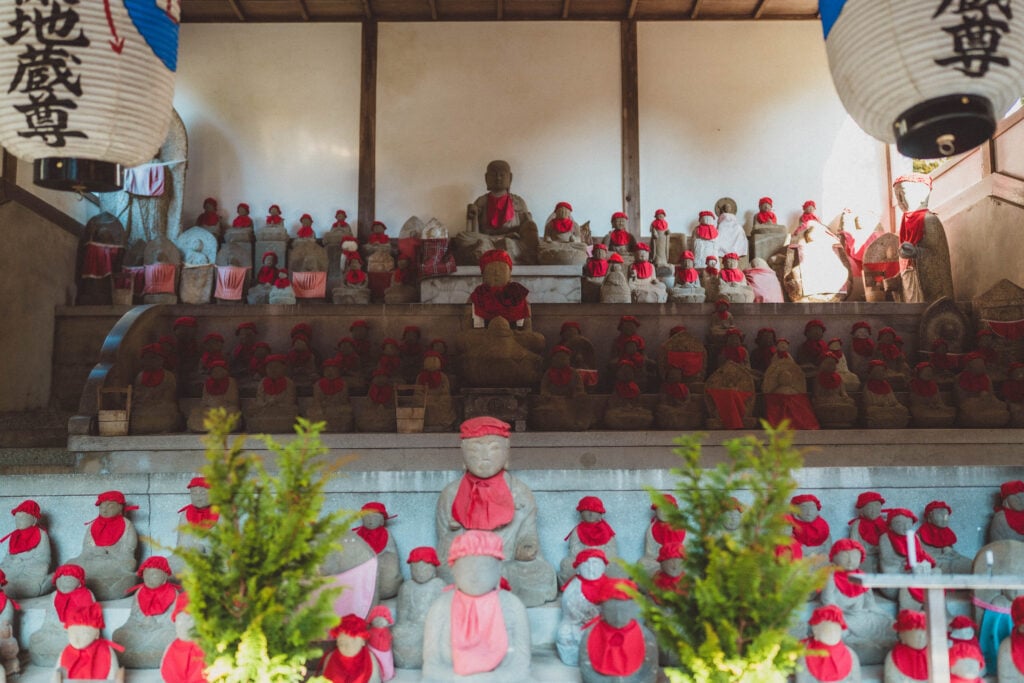
Highlights and what to see at Kiyomizu-dera
Wooden stage
One of the most notable and famous features of Kiyomizu-dera, and considered a national treasure is that of its wooden stage, which has history of an intriguing and unique tradition.
If you know the popular expression “to take the plunge” then you may be interested to know that there’s also a Japanese translation of this, which is “to jump off the stage at Kiyomizu”.
During the Edo-period the tradition was held that if a person were able to survive a 13-meter jump from the wooden stage, then they would have a wish granted. Risking death in return for a blessing, this leap of faith led to 234 jumpers, where 34 of those people died. The practice was prohibited in 1872.
The impressive wooden stage juts out from the main hall, standing nearly 13 meters high and is supported by 18 thick pillars made from zelkova trees, which are over 400 years old!
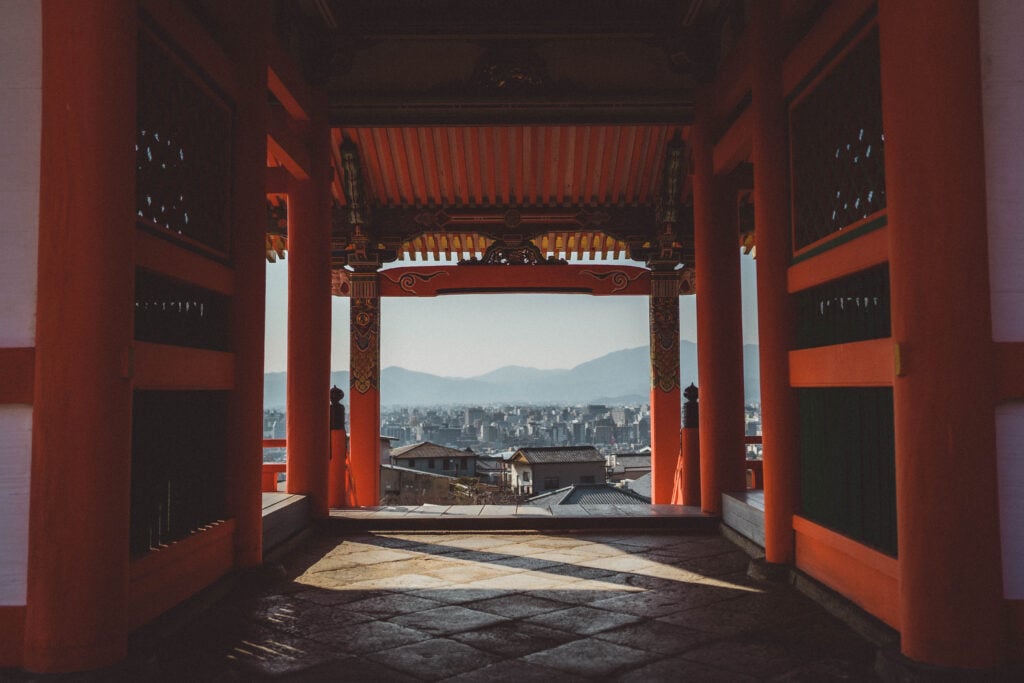
Upon walking onto the stage, visitors are blessed with sweeping panoramic views overlooking Kyoto and the natural landscape that surrounds.

Large Pagoda
Situated a little further away in the southern end of the temple complex, standing amongst the trees is a the largest of two pagodas at Kiyomizu-dera. Dating back to 1633, this structure stands at an impressive height of 31 meters, making it one of the tallest of its kind in Japan.
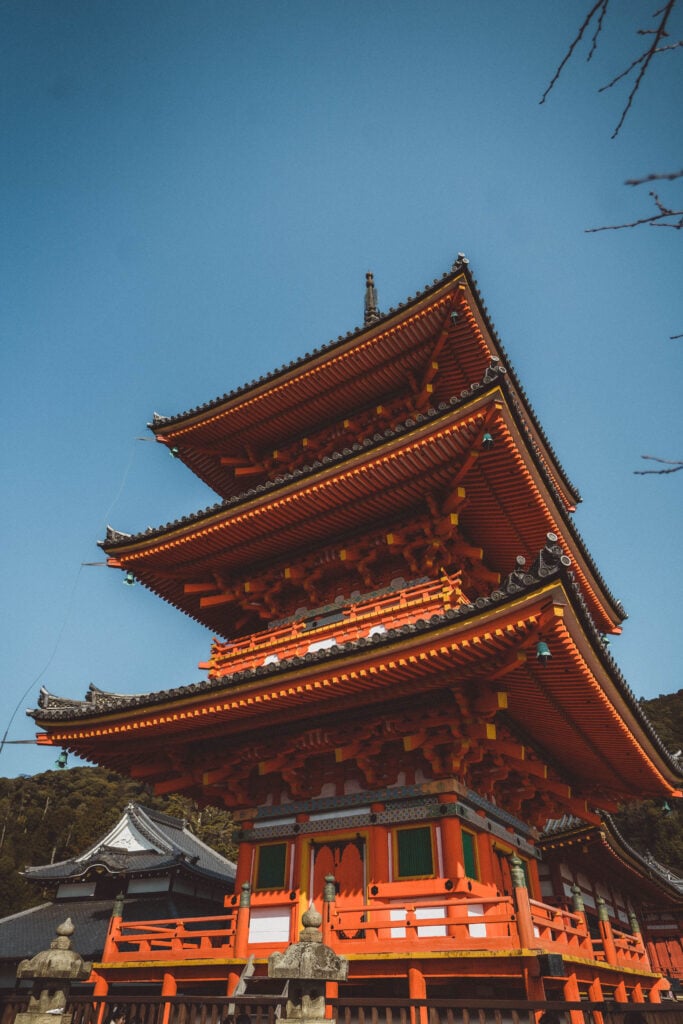
Small Pagoda
The other pagoda is a smaller replica of its larger counterpart. However, this structure is dedicated to and named after Koyasu, the “Goddess of Easy Deliverance”. It’s said that a visit to this pagoda is said to bring about an easy and safe childbirth.
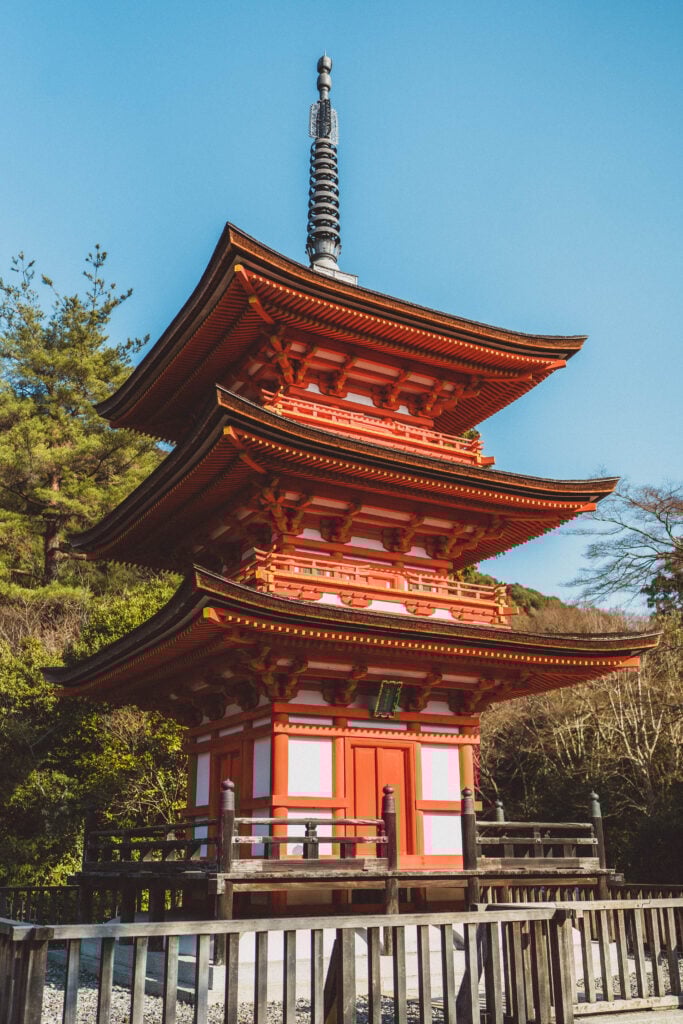
Jishu Shrine
Within the temple complex, behind the main hall, stands the Jishu Shrine. A shrine which houses various gods, it is dedicated to the deity of love and matchmaking. The shrine where visitors may worship to with the hopes of helping with their fulfilment of love.
Bell Tower
The brightly coloured bell tower was built in 1596 and is intricately decorated with chrysanthemum flowers which are carved onto the structure. It has since been restored in 1999 and is famously rung on New Year’s Eve.
Gardens
Tranquil and serene, the gardens were designed as such so that they would be lit at nighttime by the moon rising from Higashiyama, hence its name ‘The Moon Garden’.
Unfortunately the gardens are usually inaccessible to the public (there are a few special tours/guides per year) but you are able to get a glimpse of them from above on the wooden stage.
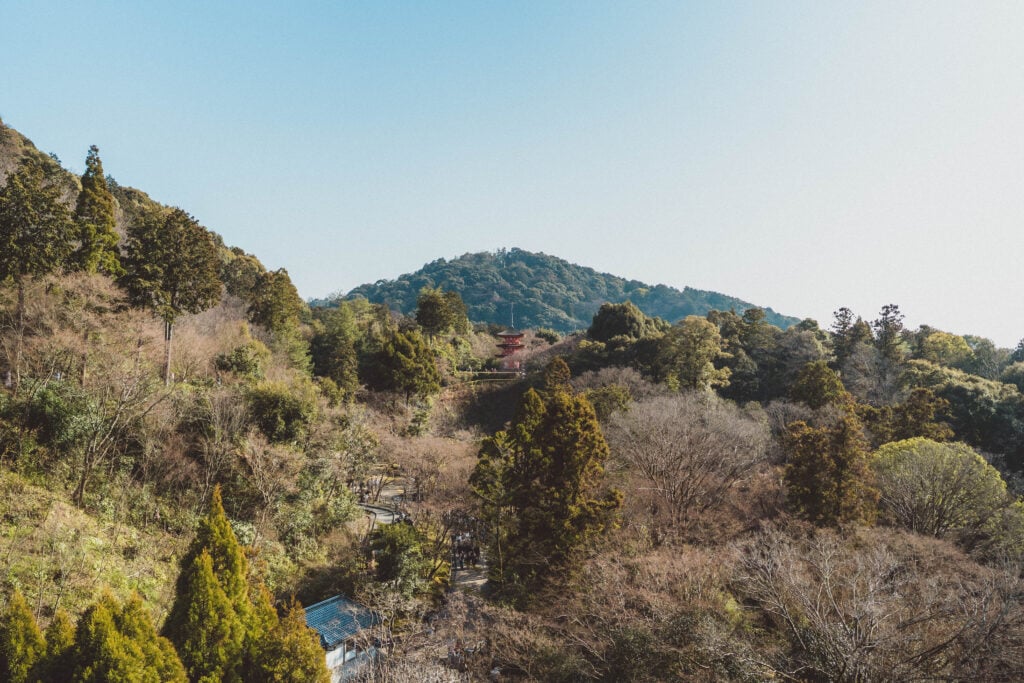
Otowa Waterfall
Divided into three separate streams, the Otowa waterfall is located beneath Kiyomizudera’s main hall and the streams of water fall over a Buddhist altar into a pool below. Each stream of water is said to have a different benefit: cause longevity, success at school and to have a fortunate love life.
Visitors are welcomed to take a cup and use a a pole to collect some of the pure spring water to drink. However, to drink from all three streams is considered to be greedy, so choose wisely!
How long do you need at Kiyomizu-dera
There’s definitely a lot to see at Kiyomizu-dera, so to ensure you experience all of the temple complex and don’t miss out on its beauty and intrigue, I strongly suggest allowing at least 2 hours to explore.
How to visit Kiyomizu-dera
Kiyomizu-dera can be reached from Kyoto Station via bus number 206, which is a 15 minute journey and costs 230 yen one-way (you have to pay exact change in cash to the buses in Kyoto and pay the fare upon exiting the bus). You can get off at either Gojo-zaka or Kiyomizu-michi stops, from there it is a short 10 minute walk up the hillside to the temple.
The one thing I would say is that the temple can get really busy as it’s one of the most popular spots in Kyoto. This is particularly true during hanami (cherry blossom viewing season) and koyo (falling leaves season).
If you want to experience the temple without too many crowds, then your best bet is to head there first thing in the morning. The street leading up to the temple through Gion is also one of the busiest spots that I experienced in Japan but when we reached the temple, it was less busy than the streets below, so do bare this in mind when planning a visit!
Looking for more inspiration while visiting Kyoto? Why not check out our guide on the best things to do in Kyoto. Or, if you have more time to explore further, read our best day trips from Kyoto guide.
If you’re currently in the planning stages of your trip, then check out our suggested Kyoto itineraries:
Enjoyed learning about Kiyomizu-dera, a cherished treasure of Kyoto? Pin this article now, read it again later: