10+ Fun, Cool, Weird & Interesting Facts About Champagne
Last Updated on 16th March 2023 by Sophie Nadeau
This post may contain affiliate links. Please check out my privacy policy and disclosure for more information.
Champagne is a wine growing region in North Eastern France that’s famed for its sparkling wine. The region is also home to quaint fairytale towns, verdant farmland, and plenty of history. Here’s some of the fun, cool, weird, interesting, and best facts about Champagne!
Please note that, as the sparkling wine and region from which it comes are eponymous, these facts will be about both the area and its famous tipple. For a greater insight into the region, here are the best things to do in Champagne.
Contents
- There is no grape or town called Champagne
- Not all sparkling wine can be called Champagne
- Champagne contains fewer calories than red and white wine
- Champagne is the coldest wine growing region in France
- The Champagne growing area is fairly small!
- Over 300 million bottles of Champagne are produced on an annual basis
- The Champagne industry is worth a lot!
- There are 3 main grape varieties used to make Champagne
- Champagne is created by fermenting the wine twice
- Dom Perignon did not invent Champagne
- 120,000 seasonal workers head to Champagne for the harvest
- The first Champagnes were known as the ‘devil’s wine’
- There is a term for opening a bottle of Champagne with a sword
- Champagne is consumed all over the world
- There are over 300 champagne houses
There is no grape or town called Champagne
Unlike some other famous drinks, the name Champagne is actually named for the region, which is located in North Eastern France, rather than a variety of grape. There is no grape called Champagne. There is also no town called Champagne.
With this being said, there are several towns in Champagne which contain the word within them, including Mailly Champagne and Châlons sur Champagne. The main towns in Champagne are Reims, Epernay, and Troyes.

Not all sparkling wine can be called Champagne
In order to be called Champagne, the drink has to be produced in a very specific corner of France. The Champagne growing region is located in North Eastern France, and not even neighbouring French regions are allowed to call their sparkling wine Champagne.
Champagne contains fewer calories than red and white wine
Typically, Champagne contains less calories than red wine or white wine. While each bottle differs, there are around 600 calories in a 750ml bottle of Champagne. Champagne is also traditionally served in smaller quantities than other types of wine.
Champagne is the coldest wine growing region in France
The region of Champagne is located around 150 km east of Paris and is the coldest wine growing region in metropolitan France due to the fact that it’s also the most Northern wine growing region!
The average annual temperature of Champagne is only 11 degrees Celsius. It’s actually this cooler weather that gives the grapes just the right acidity to make them perfect for Champagne making.
The Champagne growing area is fairly small!
The region of Champagne comprises of around 34,300 hectares, which is around double the size of the city of San Francisco.
Over 300 million bottles of Champagne are produced on an annual basis
The exact number of Champagne produced in any given year will vary depending on a variety of factors (growers are dealing with nature, after all). Weather, pests, and anticipated consumption all factor into exactly how many bottles are made.
The area is particularly susceptible to bad weather such as snow, which makes producing Champagne even harder as the budding flowers on the vine can freeze, leading to no grapes from that particular vine. But it tends to be over 300 million bottles on a yearly basis! In 2021, 315 million bottles were produced.
The Champagne industry is worth a lot!
The Champagne industry has an annual revenue of over 5 billion dollars!
There are 3 main grape varieties used to make Champagne
Champagne are largely made up of a combination of three types of grape: Pinot Noir (a red variety) Pinot Meunier (a red variety) and Chardonnay (a white variety). Pinot Noir and Pinot Meunier are the only red grapes allowed to be used to make Champagne.
Champagne is created by fermenting the wine twice
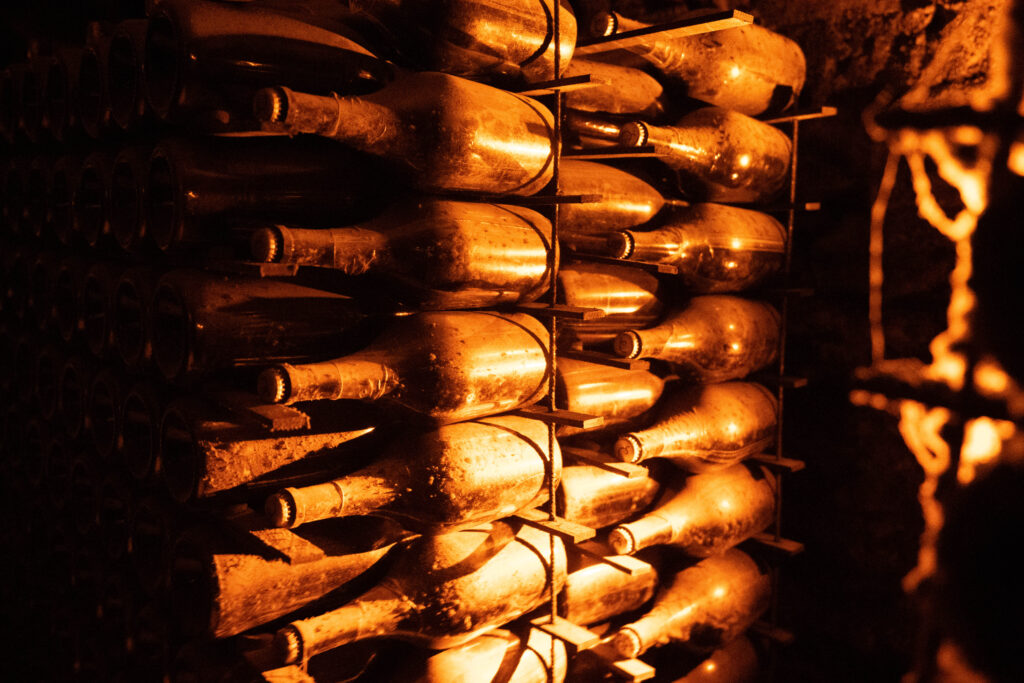
While normal (non sparkling) wine is created by a single fermentation, a double fermentation is needed to create the bubbles of Champagne that make it sparkling. The first fermentation gives a white or rosé wine.
The second fermentation is when yeast and sugar is added. This process has a legal requirement of preparation of at least 15 months for a standard champagne or 3 years for a millésime champagne.
Dom Perignon did not invent Champagne
It is a widely told myth that Dom Perignon invented Champagne. This is probably not true. However, the monk who worked as the cellar master in the Abbey of Hautvillers did improve the Champagne process a lot, leading the sparkling wine to become what it is today.
Indeed, the English physicist, Christopher Merret, documented the second fermentation process which led to sparkling wine long before Dom Perignon ever became a monk.

120,000 seasonal workers head to Champagne for the harvest
The harvest period in Champagne is a highly regulated industry. There is a three week period where grapes can be harvested. Each year, 120,000 workers are employed for a period of just under two weeks. The pickers work in a team of four people per hectare, which are known as ‘hordons’ in French.
The first Champagnes were known as the ‘devil’s wine’
The beginning of the Champagne industry was haphazard to say the least! In the beginning, the pressure of the sparkling wine was so strong that it caused many bottles to explode and corks to pop.
The wine was called ‘le vin du diable’ (the devil’s wine) as it wasn’t yet understood that a stronger glass bottle would be needed to contain the pressure. Today, Champagne bottles are made to withstand 10 atm of pressure, even though the wine itself only creates 5-6 atm of pressure. Champagne has a pressure of about 3 times greater than a car tyre.
There is a term for opening a bottle of Champagne with a sword
The technical term for opening a bottle of Champagne with a sword is “sabrage”. Of course, this technique is only really used in ceremonial contexts and should not be attempted at home!
Champagne is consumed all over the world
Champagne is exported to over 190 countries, all across the world. The biggest consumers of Champagne are the French, followed by the UK, USA, Germany, and Japan. Champagne makes up around 0.5% of worldwide vineyards and comprises of just 4% of French grape growing territory.
There are over 300 champagne houses
A champagne house is a specific business that produced Grande Marque Champagne. There are currently 360 Champagne Houses. The Champagne industry employs over 16,200 people.
Enjoyed reading about the top fun facts about Champagne? Pin this article now, read it again later: